IPTV Nordic 2026: One Region, Four Different TV Markets
IPTV Nordic in 2026: UEFA rights redrawn to 2031, a Finnish channel blackout and a VAT rise — why the same match sits on a different service per country.

If you follow IPTV Nordic coverage, spring 2026 was the season the region stopped behaving like one market. Within a few weeks, UEFA club competition rights across the Nordics were redrawn as far ahead as 2031, three Finnish free-to-air channels disappeared from one operator's cable network days before the ice hockey World Championship, and the tax treatment of public broadcasting changed. The practical result for viewers is simple and slightly absurd: the same fixture now sits on a different service depending on which Nordic country you happen to live in.
This guide explains what changed, why the Nordic TV map is fragmented in the first place, and what it means if you are trying to watch football, hockey or your home country's channels from Finland. Information checked 1 August 2026.
What "IPTV Nordic" actually means
IPTV — Internet Protocol Television — means television delivered over an internet connection instead of an aerial or a cable. That definition covers far more than people assume. Yle Areena is IPTV. The operators' own TV apps are IPTV. So is a standalone Nordic IPTV service with its own login credentials.
What matters for you is that the picture no longer arrives with your broadband contract. It arrives through an app that runs on a smart TV, a phone or a streaming stick, and your credentials travel with you. That decoupling from a physical address is exactly what makes country-by-country rights so visible — and so irritating.
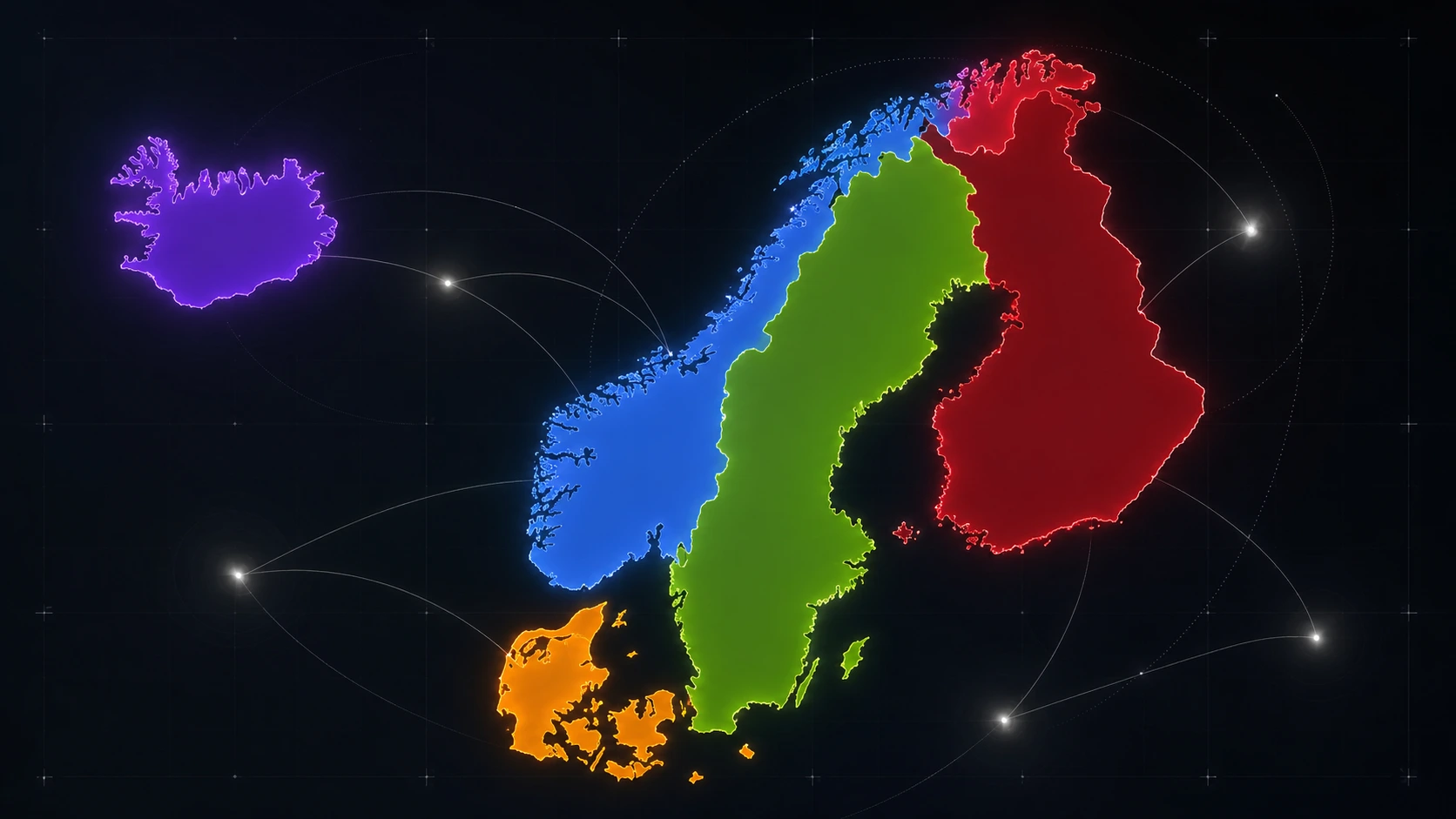
The Nordic quirk is that the region markets itself as one place while its content is licensed as four. Services describe themselves as "Nordic", but what you can actually watch changes when you cross a border. Spring 2026 made that gap unusually obvious.
Spring 2026 redrew the Nordic TV map
Individually these were small news items. Together they changed where a Nordic viewer finds what they want.
| Date | What happened |
|---|---|
| 1 Jan 2026 | The VAT rate on public broadcasting rose from 10% to 14%. The income threshold for the personal Yle tax was raised, taking around 90,000 people out of it. |
| Feb 2026 | Finnish operators raised prices on TV and entertainment packages in their annual contract revisions. |
| 30 Apr 2026 | UEFA club competition rights across the Nordics were reallocated — some deals now run to 2031. |
| 13 May 2026 | MTV3, Sub and AVA left Elisa's cable network after a carriage dispute, affecting an estimated 800,000 households. |
| 15 May 2026 | The IIHF World Championship began — two days after the blackout. |
| Jun 2026 | Viaplay launched a new Nordic sports channel carrying over 100 hours of sport a week. |
The carriage dispute is the one that hit ordinary households hardest. MTV terminated its distribution agreement with Elisa, its free-to-air channels went dark for roughly a third of Finnish cable homes, and it happened in the run-up to the hockey tournament that draws the country's largest annual audience. MTV's position was that its legal must-carry obligation is already satisfied through the terrestrial network, where the channels remained available.
For viewers the lesson was blunt: the channel line-up you pay for can change mid-season, through no decision of your own.
Why the same match sits on a different service in each country
Broadcast rights are sold nationally. UEFA does not sell one Nordic package — it negotiates Finland, Sweden, Norway, Denmark and Iceland separately. The same is true of the NHL, domestic leagues and film libraries.
The late-April 2026 settlement illustrates this neatly. According to Viaplay Group's own announcement, the company will show the UEFA Champions League in Denmark and the Europa League and Conference League in Norway and Finland through to 2031. In Finland, meanwhile, the Champions League moves to Sanoma from autumn 2027, where matches will sit on Ruutu+.
| Country | Champions League | Europa & Conference League |
|---|---|---|
| Finland | MTV Katsomo+ until Sanoma takes over in autumn 2027 | Viaplay, confirmed to 2031 |
| Denmark | Viaplay, confirmed to 2031 | — |
| Norway | — | Viaplay, confirmed to 2031 |
| Sweden | Viaplay through the 2026/27 season | — |
A dash means that right was not confirmed in these particular announcements — not that the competition is unavailable in that country. Always check the current position on the service's own site before subscribing.
The point stands regardless. A football fan in Helsinki and one in Copenhagen follow the same competition through two different services, and the Finnish fan will have to move again in 2027. Add ice hockey, Formula 1 and domestic drama, and a single household's viewing year fragments across three or four subscriptions.
Ice hockey: the clearest example of the split
Football illustrates the problem, but in Finland ice hockey demonstrates it. Hockey is the country's largest television draw by some distance, and it arrives through three separate competitions that are tendered on entirely separate cycles.
The domestic Liiga is one negotiation, sitting in recent seasons within MTV's Katsomo+ packages. The NHL — followed intensely in Finland because so many Finnish players are in it — is another, and Viaplay has been a major regional holder of it. The IIHF World Championship in May is a third, and it has traditionally been the one hockey event that reaches the widest free audience in the Nordics.
Three competitions, three rights holders, three renewal dates. A household that simply wants to "watch hockey" is not buying one thing; it is buying into three separate commercial arrangements, each of which can move at the end of its cycle. And the same three competitions are divided differently again in Sweden, Norway and Denmark, where the domestic league and the national team draw the same intensity of interest.
This is also why the May 2026 blackout stung as much as it did. It landed on free-to-air channels, in the run-up to the World Championship, in a country where hockey is the one thing close to universal viewing. The channels themselves stayed available over the terrestrial aerial network — but a third of Finnish cable households discovered, days before the tournament, that the route they had been using no longer worked.
IPTV in the Nordic countries, one by one
"Nordic" is a useful shorthand and a poor description of how television actually works here. Each country has its own public broadcaster, its own dominant commercial group and its own rights auctions.
| Country | Public broadcaster | Commercial anchor | Notable in 2026 |
|---|---|---|---|
| Finland | Yle (Yle Areena) | MTV, Nelonen/Ruutu | Carriage dispute in May; Champions League moves to Sanoma in 2027 |
| Sweden | SVT | TV4 | Viaplay holds the Champions League through 2026/27 |
| Norway | NRK | TV 2 | Viaplay holds Europa and Conference League to 2031 |
| Denmark | DR | TV 2 | Viaplay holds the Champions League to 2031 |
| Iceland | RÚV | — | Smallest market; rights are often shared rather than exclusive |
A few patterns are worth knowing if you watch across borders.
All the Nordic public broadcasters are now funded through general taxation rather than a separate device licence, which is why there is no "TV licence" to buy in Finland — you pay the Yle tax whether or not you own a television. All of them run substantial free streaming platforms, and Yle Areena in particular carries a large share of Yle's output at no cost.
Terrestrial aerial reception remains genuinely important in Finland and less so elsewhere in the region. That matters more than it sounds: it is the reason the May 2026 dispute did not black out MTV's channels entirely, and it is a real fallback for free-to-air television that cable-only households in some other markets do not have.
Commercial television is concentrated. In practice a handful of groups — Yle, MTV and Sanoma in Finland, SVT and TV4 in Sweden, NRK and TV 2 in Norway and Denmark, plus Viaplay across all of them — account for most of what people actually watch. When two of those groups fall out, as MTV and Elisa did, a large share of the country feels it at once.
That concentration also means one company's cost-cutting decision crosses the border straight into a consumer's package. Spring 2026 produced a concrete example. On 6 May 2026, SVT and UR announced that Kunskapskanalen will cease as a separate linear channel on 1 January 2027: the content moves to SVT2 and to the UR Play and SVT Play services, and SVT's linear line-up shrinks to three channels. UR's chief executive put the decision down to a strained financial situation — funding under Sweden's new 2026–2033 public service licence period rises 3% in 2026 and just 1% in 2031–2033.
For a Finnish viewer this is not foreign news. Kunskapskanalen sits in both Telia's Europe package and DNA Norra, so a Finnish subscriber loses a channel from a package they pay for, with no change to the price. The mechanism is exactly the same as rights moving between services: changes to Swedish channels and what they cost in Finland are covered separately. The direction is uniform across the Nordics — fewer linear channels, more IP delivery.
And the region's operators are not the same companies everywhere either. Elisa, Telia and DNA dominate Finnish broadband and TV bundles; the mix differs in Sweden, Norway and Denmark. A bundle that made sense at your last address may not exist at your next one — which is a decent argument for keeping your television independent of your broadband contract in the first place.
What this looks like if you have just moved to Finland
For internationals in Finland the fragmentation problem arrives on top of a language problem, and the usual advice is unhelpful.
The realistic picture is three separate things. Finnish free-to-air channels — Yle's channels, MTV3, Sub, AVA, Nelonen and others — come over the terrestrial aerial network, and Yle Areena streams a large part of Yle's output free online, with subtitles on much of the foreign-language content. Paid Finnish services carry domestic sport and drama. And your home country's channels, in your own language, are generally not part of any Finnish package at all.
That last gap is what most newcomers actually want solved, and it is the one a Finnish operator contract does not address. It is also why what the service includes matters more than the size of the headline channel number: an international line-up is only useful if it covers the specific languages and competitions you care about.
The three layers of a Finnish TV bill
Finnish households pay for television in three layers, and all three moved in 2026.
The Yle tax is collected through income taxation whether or not you watch Yle. From the start of 2026 the income threshold was raised, and according to the Ministry of Finance around 90,000 people fell out of it, while the VAT applied to public broadcasting rose from 10% to 14%.
The operator TV package is usually bundled with broadband or a housing-company contract. Prices rose in early 2026, and this is the layer carriage disputes strike — the cable line-up depends on agreements you are not party to.
Streaming subscriptions are typically two to four per household, and this is the only layer you fully control.
If you are new to the country, note that the first layer is not optional and not a subscription you can cancel. Budget for it, then decide how much of layers two and three you actually need.
Operator package, streaming service or IPTV subscription?
Most households end up with some combination of all three, but the three models behave very differently when something changes. It is worth seeing them side by side.
| Operator TV package | Individual streaming service | IPTV subscription | |
|---|---|---|---|
| Tied to | Your address, broadband or housing company | Your account | Your credentials |
| Typical commitment | Often a fixed term, bundled with broadband | Rolling monthly | Rolling, prepaid per period |
| Hardware | Usually an operator set-top box | App on your own device | App on your own device |
| If you move house | May need renegotiating or cancelling | Unaffected | Unaffected |
| If rights move | Line-up can change without your involvement | You subscribe to whoever won them | Line-up can change without your involvement |
| Cost pattern | Often invisible inside the broadband bill | Several small recurring charges | One charge per period |
Nothing here makes one model universally right. An operator package is genuinely convenient if you want a single bill and never intend to move. Individual streaming services are the only way to get specific exclusive content the moment it matters. What an IPTV subscription changes is the coupling: your viewing stops depending on which broadband contract you signed and which carriage negotiations went well this year.
The honest weakness of every model on that table, including ours, is the same one: none of them controls the rights. What differs is how expensively you find out when they move — and a rolling, prepaid arrangement is the cheapest way to be wrong.
Where a Nordic IPTV subscription fits
A fragmented market is precisely why standalone IPTV services have grown across the Nordics. When the channel line-up does not arrive with your broadband, your viewing is no longer hostage to your operator's contract negotiations.
Nordic IPTV works on that model. After subscribing you receive credentials that go into a compatible app, and they work regardless of whose broadband you use. The line-up runs to over 18,000 live channels plus more than 40,000 films and 12,000 series, in 4K and FHD wherever the source provides it, with a full EPG and catch-up for programmes that have already aired.
Three practical differences from an operator package. There is no fixed term — subscription prices start at €15 a month and fall to roughly €5.40 a month on the annual plan, each billed once with no automatic renewal. Hardware is your choice: supported devices include smart TVs, Android TV boxes, the Fire TV Stick, Apple devices, computers and phones, with no operator set-top box involved. And plans include two to five simultaneous streams, so the household can watch different things at once.
We are not going to claim this replaces every channel a Nordic viewer might want. Rights are national and they move, as spring 2026 demonstrated twice over. The honest framing is that one flexible subscription covers a large share of viewing without locking you in, alongside what the terrestrial network and individual services already give you. If you want the detail rather than the summary, the full line-up and features page sets out what is actually included.
Devices, apps and the words you will meet
Because IPTV arrives through an app rather than a box, the hardware question becomes a software question — and the vocabulary trips people up more than the technology does.
On hardware, almost anything with a screen works. Smart TVs running Samsung's Tizen or LG's webOS, Android TV and Google TV sets, the Amazon Fire TV Stick, Apple TV, phones and tablets on iOS and Android, Windows and Mac computers. An older television without smart features is not a problem either: a cheap streaming stick turns it into a compatible device for less than a month's subscription. The device list covers the specifics.
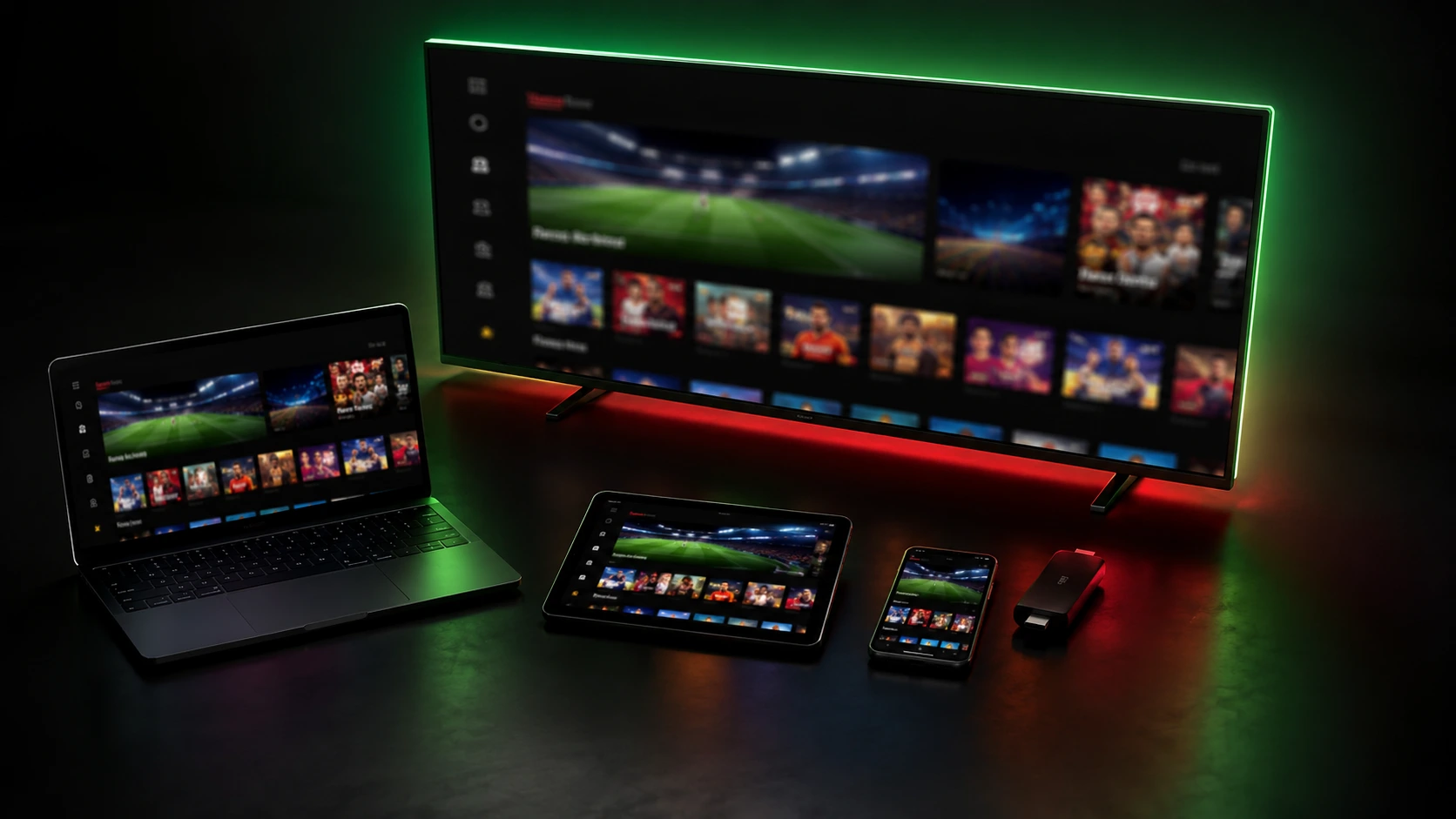
On software, the common players in the Nordics are IPTV Smarters Pro, IBO Player and TiviMate, with Smart IPTV and XCIPTV also widely used. The first is by far the most common starting point and also the one with the most counterfeit builds in circulation, so it is worth knowing how to spot the genuine app before you install anything. You enter your credentials once, the app pulls down the channel list and the guide, and that is the setup finished. Nothing needs reinstalling if you change broadband provider or move to another country.
The terminology is worth ten seconds each:
| Term | What it means in practice |
|---|---|
| EPG | The on-screen TV guide — what is on now and later, browsable by channel |
| Catch-up | Watching a programme after it has aired, without having recorded it |
| VOD | On-demand films and series, as opposed to live channels |
| M3U | A playlist file format some services use to deliver a channel list |
| Xtream Codes | A common login method: username, password and a server address |
| HLS | The streaming protocol that adapts quality to your connection speed |
| Multiroom | Watching on more than one device at the same time |
| DVB-T2 | The terrestrial aerial standard used for Finnish free-to-air television |
If your setup does not match any of these descriptions, that is a reason to ask rather than guess — message us before you subscribe and we will tell you whether your device is workable.
Is IPTV legal in the Nordics?
This question comes up constantly and deserves a straight answer in two parts.
The technology is legal. IPTV is simply a delivery method, and the largest broadcasters in the Nordics use it themselves. The question is never about the protocol.
What matters is whether the content carries proper licensing. In Finland, Traficom regulates communications networks and services, the Copyright Information and Anti-Piracy Centre (TTVK) handles copyright enforcement, and the Finnish Competition and Consumer Authority (KKV) covers consumer rights. Enforcement conditions shifted during 2026 in a way that makes providers much easier to check — what the legality question actually turns on is covered in its own article.
When judging any provider, look at practical signals: is there a real support channel with a real person behind it, are prices and terms stated plainly, and can you test the service before paying? "Lifetime" subscriptions sold for a single payment are not a realistic promise from anyone. On our side, who we are and how the service works are set out openly, and the FAQ page answers the most common questions before you commit to anything.
How to choose a service that survives a rights change
The lesson of spring 2026 is that no service stays the same for the length of a contract. Choose for flexibility rather than for today's channel list.
- Avoid long fixed terms. If rights move mid-season, a two-year contract ties you to a service that no longer shows what you signed up for.
- Check what your access is tied to. Anything bound to an address, a router or a broadband account breaks when you move or travel. Credential-based access does not.
- Add up the whole bill. The Yle tax, the operator package and your streaming subscriptions together are the real number — comparing single line items hides it.
- Test before paying. Picture quality and stability depend on your connection and your device, and no marketing page can tell you how they will behave in your flat.
- Check how support is reached. Channel changes and app problems eventually happen to everyone; what matters is the response time when they do — and it is one of the few things reading IPTV reviews can actually predict.
On connectivity, the bar is modest: 15 Mbps is enough for HD and 25 Mbps for comfortable 4K. Finnish connections clear both easily, so stuttering is nearly always a Wi-Fi issue rather than a line issue.
If a channel disappears mid-contract
It happened to 800,000 households in May, so it is worth knowing the sequence.
First, check whether the channel is genuinely gone or merely gone from your route to it. Finnish free-to-air channels remained on the terrestrial network throughout the MTV–Elisa dispute; households with an aerial connection were unaffected. A cheap aerial is a real fallback in Finland in a way it is not in every European market.
Second, read what you were actually promised. Operator contracts generally describe a service rather than a guaranteed list of specific channels, which is precisely why line-ups can change without breaching anything. If you believe a term has been broken, the Finnish Competition and Consumer Authority is the body that handles consumer disputes of this kind.
Third, decide whether it is worth switching at all. Carriage disputes are frequently resolved within weeks; rights reallocations are permanent. Reacting to the first as though it were the second is an easy way to sign a new fixed-term contract you will regret.
What to watch for in 2027
Two dates are already on the calendar. In autumn 2027 the Champions League changes home in Finland, moving to Sanoma's Ruutu+ — which will matter to anyone whose current subscription was chosen for that competition. And the Viaplay arrangements for Denmark, Norway and Finland now run to 2031, meaning those parts of the map are settled for several years.
The gaps in the table earlier in this article are the interesting part. Where a right was not confirmed in the April 2026 announcements, it is still in play, and the next auction cycle will decide it. If your viewing depends on a single competition, that is the thing to track before signing anything longer than a year.
The short version
The Nordics look like one television market and are legally four — and spring 2026 made the difference impossible to ignore. UEFA rights were split country by country out to 2031, the Champions League changes home in Finland in 2027, three free channels vanished from one cable network mid-tournament, and the tax layer of the bill went up.
You cannot influence how rights are carved up. You can influence how tightly you are bound to any single provider. A flexible, credential-based subscription with no fixed term absorbs these changes far better than a two-year contract does.
To put numbers against your current setup, compare the plans — or test the quality on your own device and connection first and start a free trial.