IPTV kanavat 2026: how channel line-ups really work in Finland
IPTV channels in Finland: a channel list is a snapshot, not a product. How to read a line-up — and why even the antenna network reshuffled in 2026.
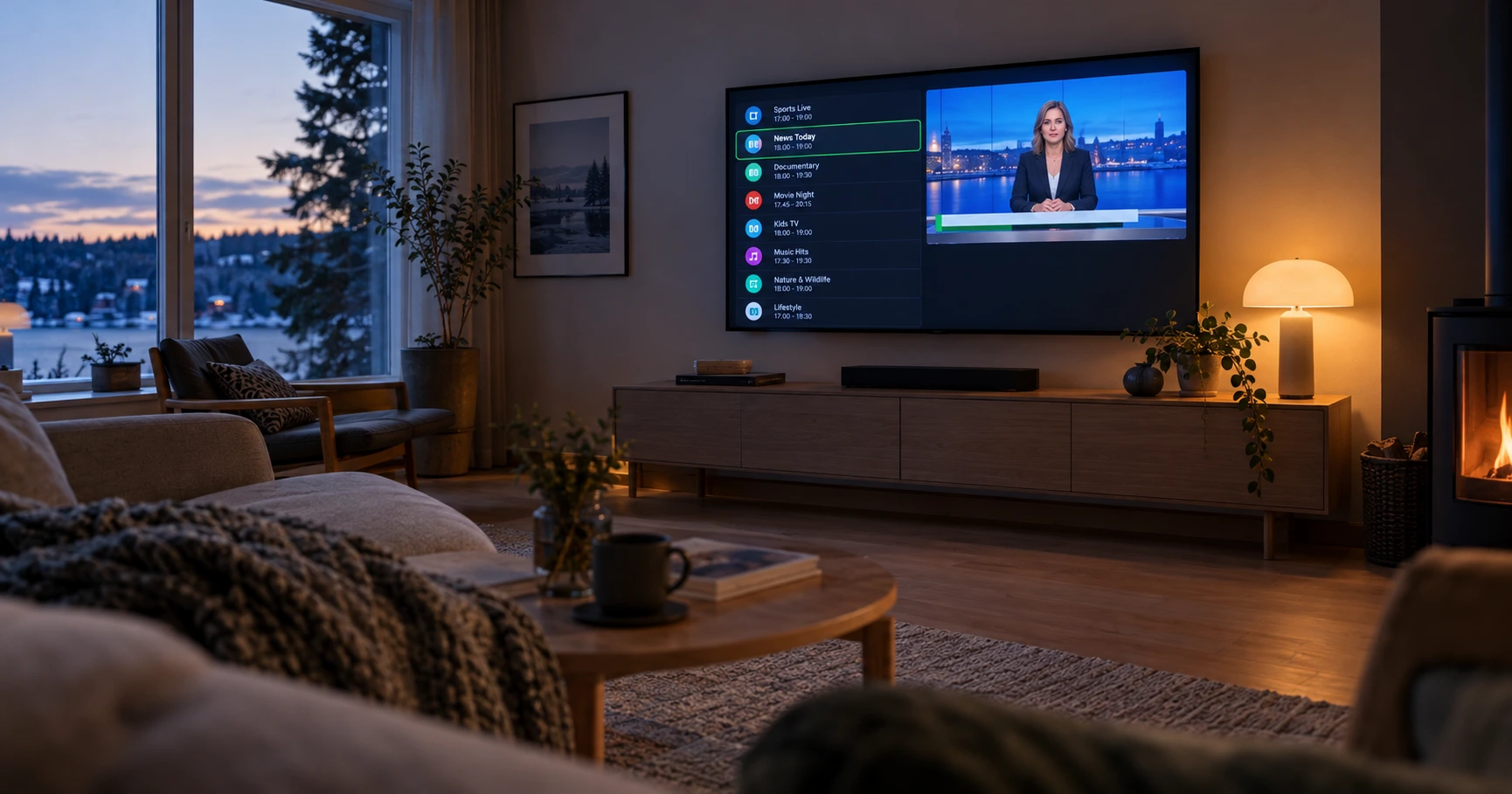
If you have moved to Finland, the channel question usually arrives early and gets answered badly. Kanavat is Finnish for channels, and searching for "IPTV kanavat" generally means one thing: what will I actually be able to watch? The answer matters more than it sounds, because most disappointment comes from treating a channel list as a product. It is not a product. It is a snapshot of a set of contracts, and it shifts constantly — including in the place you would least expect.
What "IPTV kanavat" means in practice
IPTV means television delivered over an internet connection. A channel arrives in a player app rather than through an aerial socket, and for a viewer the difference is smaller than the technology suggests: the channel opens the same way, and picture quality depends on connection speed rather than delivery route.
The real difference is the character of the line-up. On the antenna network the selection is small and fixed but very stable. It is defined in licences years ahead, and changes are rare and announced. Online the selection is wide but mobile. The more channels there are, the more contracts sit behind them, and the more often something shifts.
From that follows the whole point of this article. The length of a channel list is not a quality measure. The useful measure is whether it overlaps with your own viewing, and what happens when it changes.
A channel is not a product, it is a contract
When you buy a channel package you are not buying a channel list. You are buying a snapshot of one. Three separate contractual layers sit underneath, all of them time-limited and all renewing on different schedules:
- Broadcasting rights. Who may show which content, in which territory, and for how long. These are country-specific and often short.
- Distribution agreements. Which route carries the channel into the home — aerial, cable, an operator's network, the open internet.
- The broadcaster's own decisions. A channel can close, merge, or move to streaming only without anybody's contract expiring.
None of these is within a subscriber's control, which is exactly why a line-up change is not a sign of a poor service. It is the industry's normal state. In the Nordics this is most visible in sport, and it has its own article — the redrawing of rights explains why the same match appears on a different service in each country.
The contract structure also explains why changes often hit several services at once. When a competition's rights move from one holder to another, it vanishes from every package that relied on the old holder — operator bundles, streaming services and standalone subscriptions alike. A subscriber sees only the result in their own line-up and naturally concludes that their service got worse. Usually it was a market-wide move.
A second consequence is that the schedules are out of step. Rights renew seasonally, distribution agreements annually, licences rarely. So a line-up does not change once a year in one tidy batch; it twitches throughout the year, frequently mid-season. This is why nobody in the industry can honestly promise a channel list far ahead.
2026 proved the point on the antenna network too
If any delivery route in Finland is stable, it is the terrestrial network: licences run for ten years and Traficom regulates it. Even so, it reorganised its channel bundles during 2026.
According to Traficom's own page:
| Change | Effective |
|---|---|
| Bundle Mux-A corresponds to the former Mux-B network | 1.2.2026 |
| Bundle Mux-D corresponds to the former Mux-E network | 14.6.2026 |
Two things are worth reading correctly here. First, no channels were shut down — this is a reorganisation of frequencies and bundles, not a reduction of the line-up. Second, it was not invisible to viewers: after the work, antenna households may need to run a channel rescan, or channels appear to be missing when nothing is actually broken.
That is a useful corrective, because it inverts the common assumption. People treat terrestrial as immutable and online services as unstable. In reality both change — the difference is that on the antenna network change is rarer, announced in advance and documented by the regulator.
The antenna line-up, though, is exceptionally stable, and that is worth knowing as a benchmark. On 1 September 2026 Traficom granted programme licences for 11 January 2027 to 10 January 2037 to every applicant, and says provision continues largely as it is. The terrestrial channel list is effectively fixed for a decade — which is precisely why it makes a good reference point for how much more mobile an online line-up is.
Why a channel count tells you so little
"18,000+ channels" is a typical figure in this industry, and it is true of us too. It is still a poor basis for a decision, and it is worth understanding why.
A large total spans dozens of languages and regions. A single Finnish household typically watches fewer than thirty channels, and of those, fewer than ten regularly. The rest are not worthless, but they are not your value.
Two practical conclusions follow:
- Two services can quote the same channel count and differ completely in whether they cover your viewing. Comparing the numbers tells you nothing about which you would prefer.
- The right question is named, not numerical. "Do you carry X?" is verifiable immediately. "How many channels do you have?" leads to no decision at all.
The same logic governs price comparison: the total matters, not any single line. There is a method for that in our IPTV price comparison.
Five things that actually matter in a line-up
| Factor | Why it decides |
|---|---|
| Overlap with your own viewing | three or four named channels cover most households' daily use |
| Language and subtitles | the same channel from another country can be a different language edition |
| The programme guide (EPG) | without a guide a channel list is a catalogue, not a usable interface |
| Category structure | 18,000 channels without working categories is unusable |
| Behaviour during change | what happens, and what you are told, when a channel goes |
The last is asked least often and matters longest. The line-up will change at some point, and what counts then is whether you are informed and whether an alternative route to the same content exists.
Category structure deserves elaboration, because it is easy to underrate. With thousands of channels, browsing is not a realistic way to find anything. Usability comes from three things: a search that finds a channel by name; categories sorted by language and genre rather than only by country; and a favourites list that survives changing device. If any one is missing, a wide selection turns into a liability.
Assess the overlap concretely rather than by impression: write down what the household actually watched over the past month. That list is usually far shorter than people expect, and it is what a line-up should be compared against — not a channel count, and not an aspirational wishlist.
Language is a bigger question than most expect
The same channel name can mean different things in different countries. In international line-ups a channel often has several national editions differing in audio track, subtitles and ad breaks. On documentary and children's channels this is the rule rather than the exception.
For a household in Finland that means three checks. Is there a Finnish-language edition, or only subtitles? Are subtitles included or separately selectable? And does the time zone match — a neighbouring country's edition broadcasts the same programme at a different hour.
For a Swedish-speaking or bilingual household the question is sharper still, because Swedish channels are not part of the mainland Finnish terrestrial network at all. That situation is covered separately in our article on Swedish channels.
In families with children, language is often what decides the whole choice. For children's programming the original language is rarely the one you want to watch in, and a dubbed audio track is a different thing from subtitles. The channel's national edition determines this, not the channel's name — so ask about the audio track rather than the channel.
A third angle applies specifically to people who have moved here. Finding your home country's channels is usually the single reason a standalone subscription gets considered at all, and channel count is an exceptionally misleading measure for it: what decides the outcome is the depth of one country's provision, not the overall total. Here too a named question is the only way to get a verifiable answer.
The programme guide and categories
A wide channel list without structure is worse than a narrow one with good structure. Two things determine whether it is usable.
The EPG, or electronic programme guide, tells you what is on now and next. Without it you browse blind. When a line-up spans several countries the guide comes from different sources and appears in different languages depending on the channel — not a fault, but a consequence of channels originating in different countries.
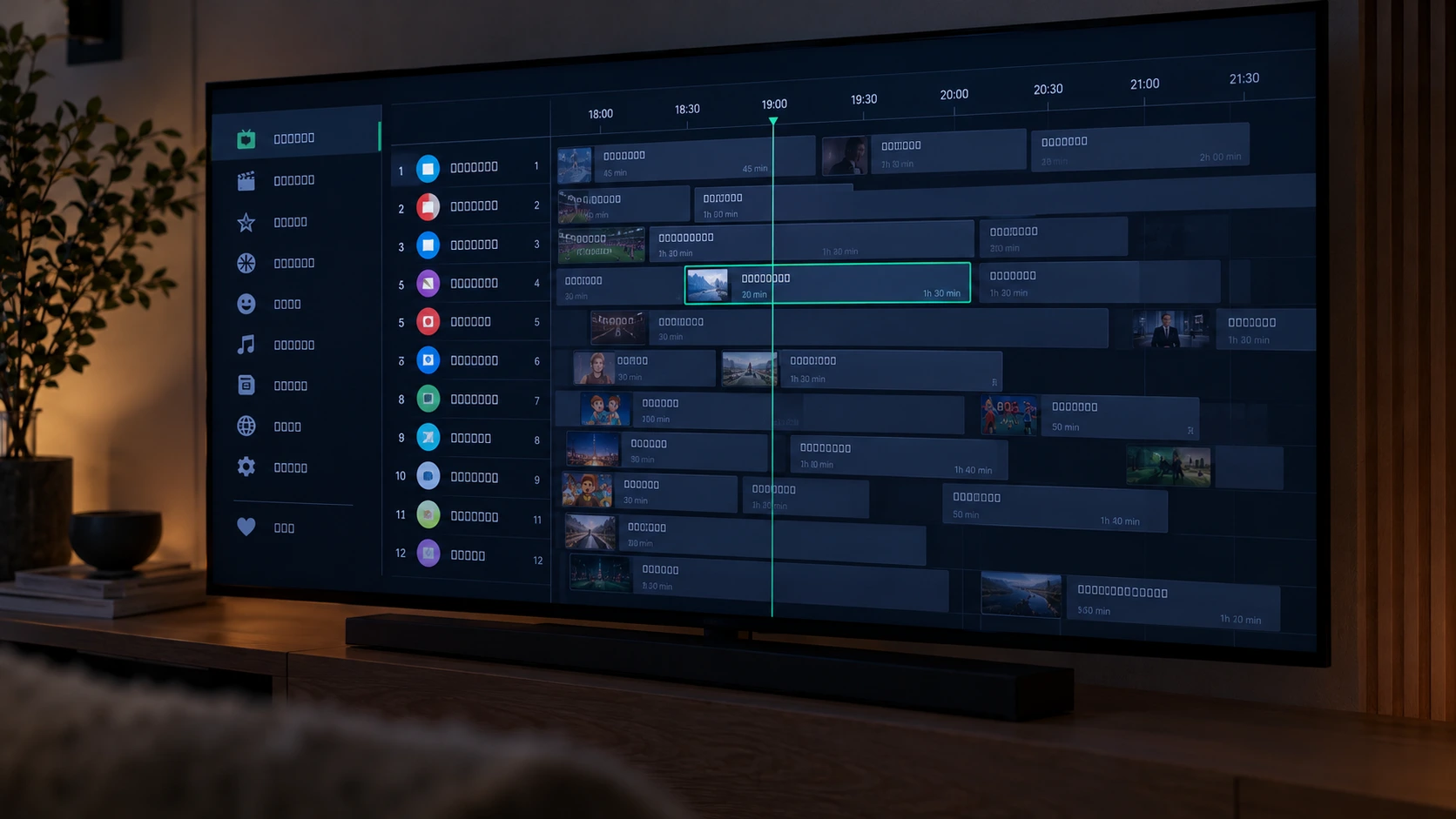
Categories and favourites decide daily use. In practice every household builds itself a favourites list of ten to twenty channels and lives in that, not in the full line-up. The first thing worth doing after subscribing is exactly that list — it changes the experience more than any other single setting.
Player options and how they differ are covered in our article on players, and supported hardware is listed on our devices page.
Finnish channels: what you get without paying anything
This is worth stating plainly, because it saves money. The domestic free-to-air channels require no separate subscription:
- From the antenna network they arrive with no internet at all, already funded through the Yle tax.
- From the broadcasters' own services — Yle Areena, MTV Katsomo, Ruutu — they are free or ad-funded online.
- From televisions' own FAST services there is a further set of ad-funded channels with no subscription.
The value of a paid subscription therefore comes from what those do not cover: international channels, a deeper film and series catalogue, and other countries' provision. If your needs are met by the domestic free channels, buy nothing — and we would rather say so beforehand than afterwards.
The limits of the domestic services are worth knowing too, because they get overestimated as often as underestimated. The broadcasters' own services are comprehensive for their own productions, but their viewing windows are time-limited: a series may be available for a few weeks after broadcast and then go. Live output is generally there, but archive depth varies sharply between programmes.
The hardware side of the aerial route, including why a DVB-T2 tuner alone is not enough in a receiver, is covered in our article on the digiboksi.
What to do when a channel disappears
The order matters, because it separates a line-up change from a fault.
- Try another device. The same credentials on a phone over mobile data tell you immediately whether it is the device or the line-up.
- Run a channel rescan if it is aerial or cable. This is precisely what resolved the 2026 bundle changes in most homes.
- If the channel is missing everywhere, it is a line-up change. That is not a fault and not fixable from the device end.
- Ask about an alternative route to the same content. Often the same series or competition is on another channel or on demand, even though the original channel went.
- Do not switch service first. If the cause is a rights transfer, it hits every delivery route the same way and switching achieves nothing.
A concrete example is worked through from the operator side in our article on Elisa's television year, where channels vanished mid-season.
One distinction is worth internalising. On aerial and cable you can fix the situation yourself with a rescan — the scan sits under Tuning or Channel search, and cable households scan with DVB-C settings while antenna households use DVB-T2, picking the wrong one being the commonest reason a scan finds nothing. In an online service a channel's removal is not fixable from the device at all, because the change happened at the source. So always diagnose with a second device first.
What to ask before subscribing
A good question is named, verifiable and tied to your own needs. Three that work:
- "Do you carry X, and in which language?" — the answer is yes or no, and checkable at once.
- "Is there a programme guide for those channels?" — decides usability.
- "What happens if that channel is removed?" — tells you more about a provider than any channel count.
A bad question is numerical or general: "how many channels", "do you have all the channels", "do you have all the sport". None can be answered honestly in a way that helps you decide.
A trial is a better source of information here than any list, for a simple reason: you see the selection on your own device over your own connection, and you need take nobody's word for it. It also reveals two things a channel list cannot — whether the programme guide works on the channels you intend to watch, and whether the picture holds up on your connection during the evening peak.
The wider picture of the Finnish television year is collected in the IPTV Finland pillar guide, and the plan details are public.
What Nordic IPTV is, and what we don't claim
We are a credential-based streaming service, sold and supported over WhatsApp. The line-up carries 18,000+ live channels, 40,000+ movies and 12,000+ series, and the same credentials work on a television, a phone, a tablet and a computer.
What we do not claim, and this is the most relevant point in this article: we do not promise any individual named channel or sports right permanently. Line-ups change, and anyone promising otherwise is promising something they cannot control. We also do not claim to replace the antenna network or the domestic free services — those are partly free and worth keeping alongside.
What we can do: check a named channel against the line-up before you pay, and tell you straight if it is not there.
Plans are €15 for one month, €35 for three, €45 for six and €65 for twelve, about €5.40 a month on the annual plan. There is no fixed term and no auto-renewal, and simultaneous streams run from two to five depending on the plan. Prices checked 9 Oct 2026. Unclear points are worth raising first — the frequently asked questions cover most of them.
Summary
IPTV kanavat is a question that cannot be answered with a list, because the list goes out of date. A channel is not a product but the outcome of three contractual layers: broadcasting rights, distribution agreements and the broadcaster's own decisions. When one shifts, the list shifts — and that is not a sign of a poor service but the industry's normal condition.
2026 demonstrated this even where provision is most tightly regulated. According to Traficom, bundle Mux-A corresponds to the former Mux-B network from 1 February 2026 and Mux-D to the former Mux-E from 14 June 2026. No channels closed, but after the changes antenna households needed a rescan — so even on terrestrial, viewers had to act.
The practical conclusion has three parts. Do not buy on channel count, because the number says nothing about overlap with your viewing. Name three or four channels that genuinely decide it for you and ask about those before paying. And check first what you already get free from the antenna network and the broadcasters' own services, because that defines what a paid subscription actually needs to cover.
To see the selection on your own device before deciding, start with a free trial or see the plans and prices.