IPTV in Finland 2026: What It Is, What It Costs, How to Start
IPTV in Finland explained for newcomers: how Finnish TV actually reaches homes, what it costs, what changes in 2027, and how to get set up.
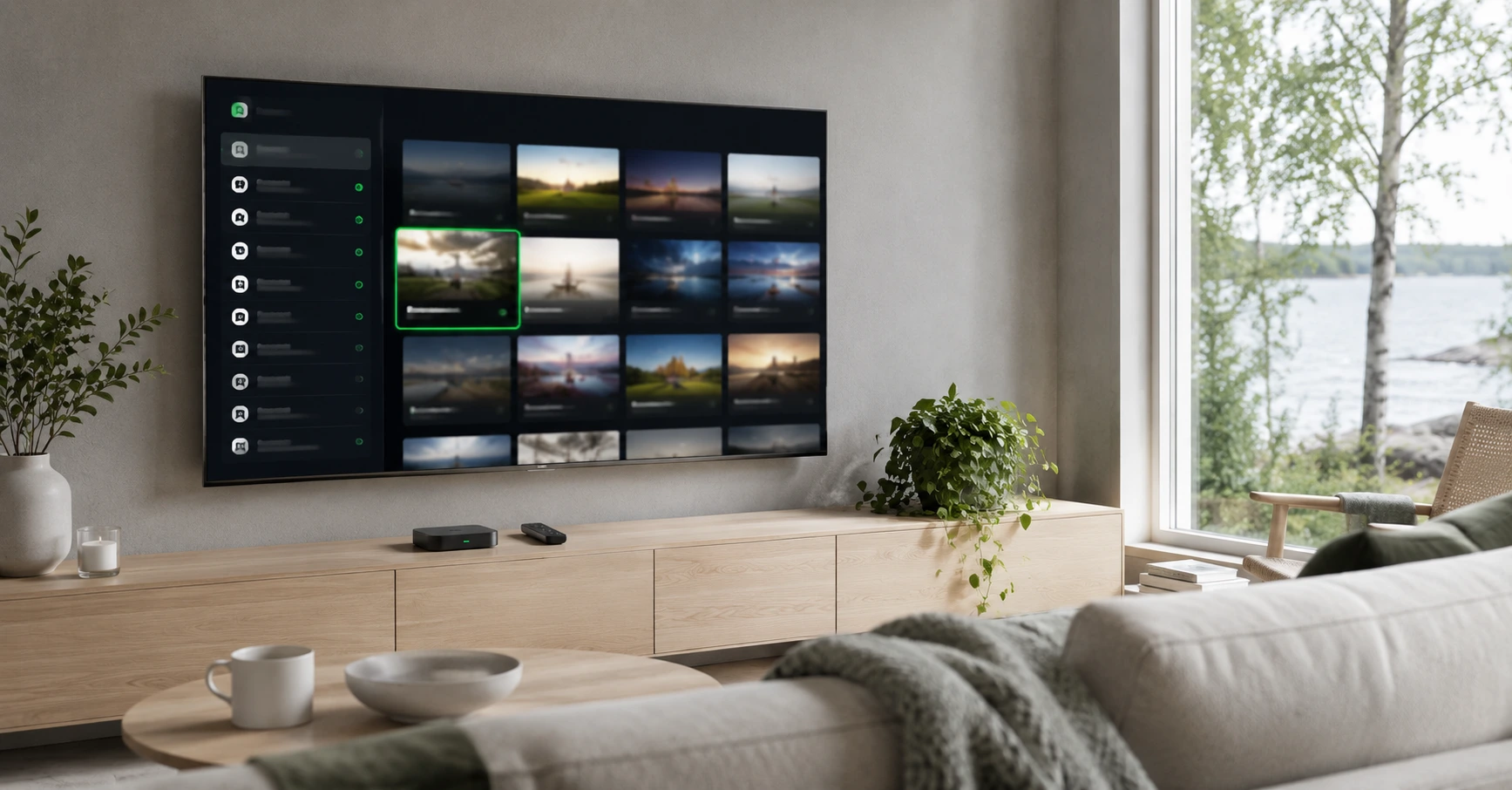
If you have moved to Finland, IPTV is probably the answer you will land on after discovering that a standard operator TV package does not carry a single channel from home. That is the usual route into this question, and it is worth answering properly: what IPTV actually is, how television reaches Finnish homes, what the real cost is once everything is counted, and what is about to change.
2026 is an unusually good moment to look at this, because the Finnish television landscape is moving from two directions at once. The licences that decide what the aerial carries are being redistributed for a full decade, and the public broadcaster's funding is being cut substantially next year. Neither changes what is on your screen tomorrow, but both shape the decade ahead. Information checked 19 August 2026.
What IPTV means in Finland
IPTV — Internet Protocol Television — means the picture arrives over an internet connection instead of an aerial or a cable. It describes the delivery method, not the content.
That distinction matters more than it sounds, because Finland's best-known and entirely lawful services are technically IPTV. Yle Areena is IPTV. MTV Katsomo is IPTV. Elisa Viihde, Telia Play and DNA's TV services are IPTV. When someone asks what IPTV is, they are almost always asking something more specific: where the channels come from, what they cost, and what the subscription ties them to.
Two practical differences separate it from traditional television. First, the picture comes from an app installed on your own device rather than arriving with your broadband line. Second, credentials are not tied to an address — the same login works at home, at a summer cottage, and abroad, as long as the connection is stable.
IPTV also does not replace anything. Yle Areena, Ruutu and MTV Katsomo remain their own apps and work alongside it. In most households the end state is a combination: the free domestic services in their own apps, and a separate subscription covering what they do not.
How television reaches a Finnish home
There are essentially four routes into a Finnish living room. Knowing which one you are on explains almost every cost and almost every outage.
| Route | Where the picture comes from | Tied to | Typical cost |
|---|---|---|---|
| Terrestrial (antenna) | Digita's masts, DVB-T2 | The receiver and the location | Covered by the Yle tax; pay channels extra |
| Cable | Building or operator cable network | The address, often the housing company | Inside the maintenance charge or operator bill |
| Operator IPTV | The operator's own broadband line | The line and the address | Monthly, usually bundled with broadband |
| Credential-based IPTV | Any stable internet connection | Credentials only | Billed per period, separately |
The first three are infrastructure. They require something physical — an aerial, a cable, a particular operator's line — and they stop working when that physical thing changes. The fourth does not. This is the central distinction in the whole subject.
Viewing habits have shifted quickly. Finnpanel's annual TV review puts time spent in front of the television at roughly three and a half hours a day, but a growing share of that is something other than linear channel viewing — among under-45s, streaming has become the dominant form of moving-image consumption. Television is not disappearing. What people watch on it, and where it comes from, has changed.
January 2027: the aerial is redealt for a decade
This is the most significant Finnish television story of 2026, and it has gone almost unnoticed in consumer coverage.
Terrestrial broadcasting licences — the right to transmit channels over the antenna network — are time-limited. The current period is ending, and Traficom opened applications in May 2026 for the period 11 January 2027 to 10 January 2037. That is a full decade.
On offer were the national UHF multiplexes A, B and C, plus a regional multiplex for Ostrobothnia. Each national multiplex carries 32.5 Mbit/s using DVB-T2, with 18 Mbit/s of multiplex A reserved for Yle. The Ostrobothnia regional multiplex is defined more flexibly — 22 Mbit/s on older DVB-T, or roughly 36–40 Mbit/s on DVB-T2.
Applications closed on 15 June 2026. According to Traficom the applicants were the established names: Discovery Networks Finland, MTV Oy, Sanoma Media Finland, Disney's Nordic arm and Viaplay Group Finland applied for national capacity, and Elisa Oyj applied for the Ostrobothnia regional multiplex. Traficom grants the licences where capacity is sufficient; where it is not, or where a decision could materially affect the development of the communications market, the decision goes to the Government.
Three things follow for a viewer.
The aerial line-up is being fixed for a long time. What the antenna carries in 2030 is effectively being decided now.
The hardware requirement has already tightened. Finland completed its transition to high definition in 2025, and the national multiplexes are specified for DVB-T2. An older DVB-T-only receiver will not carry the national HD services. If your television is a decade old, check this.
The aerial is not going away. That licences are being issued for ten years, and that the largest commercial broadcasters applied, says the opposite. It remains the cheapest way to get Finland's free domestic channels.
The Yle tax, and why it surprises newcomers
Finland has no television licence you can decline. Public broadcasting is funded through the Yle tax, collected via income taxation, and it applies whether or not you own a television set.
This catches most new arrivals off guard, because in many countries the equivalent fee is tied to owning a device or is opt-in. Here it is neither. If you are tax-resident and your income passes the threshold, you pay it regardless of which services you subscribe to. Åland, the autonomous Swedish-speaking region, runs its own separate media fee instead — a genuinely different system, covered in our article on television on the islands.
The relevant news is that the public broadcaster's funding is being reduced. According to Yle's own reporting, funding is being cut by €66 million in 2027. That figure comes from two components: the index that annually raises Yle's funding was frozen for three years covering 2025–2027, worth roughly €47 million by 2027, and the VAT rate applied to Yle's appropriation rose from 10% to 14% at the start of 2026, worth roughly €19 million a year. Yle must also increase its purchases from independent domestic producers by 15–20% by 2030, and its CEO has said the change affects both programming and headcount.
For you as a viewer the implication is simple. The tax stays; the output funded by it narrows. More of what people actually want to watch moves to paid services.
What it costs once you count everything
This is where the honest arithmetic lives, and almost nobody does it.
Finnish household TV costs sit in three layers. The Yle tax is layer one and is not a choice. The operator or housing-company TV component is layer two, and it usually travels inside a broadband bill or a maintenance charge where you never see it itemised. Streaming subscriptions are layer three — typically two to four of them, charged on different days to different cards.
Only the third layer is adjustable by decision alone. That is exactly why the total surprises people the first time they write it down.
A worked example
| Layer | Item | How it is charged |
|---|---|---|
| 1 | Yle tax | Through taxation, not a choice |
| 2 | Broadband with a TV component | Monthly, rarely itemised |
| 2 | Housing company cable TV | Inside the maintenance charge |
| 3 | Streaming service 1 | Card, monthly |
| 3 | Streaming service 2 | Card, monthly |
| 3 | Sports package for the season | Card, often fixed-term |
Six lines, of which only the bottom three are adjustable — and only one of them appears monthly in a form you actually notice. Layers one and two are the ones that go uncounted.
Our own pricing is public and deliberately simple. Plans are €15 for one month, €35 for three, €45 for six and €65 for twelve — about €5.40 a month annually. Each is billed once, with no automatic renewal, no fixed term, and a 7-day money-back guarantee.
One honest note on pricing generally: a very low price is not by itself a good sign. Content rights are time-limited and repurchased every year, so nobody can realistically sell permanent access for a single payment. A "lifetime subscription" is not a bargain, and checking who is behind a service is worth doing before paying, whoever you are considering.
What your connection needs to be
Finland is in an unusually strong position here, which is worth knowing before worrying about speed.
The recommendation is modest: 15 Mbit/s for HD, 25 Mbit/s for smooth 4K. Those are low numbers by Finnish standards. According to Traficom's statistics, fibre networks covered around 80% of Finnish households as of September 2025, a connection of at least 100 Mbit/s was available to 86%, and gigabit service to 80%. Fast 5G networks reached 93% of households by December 2025.
So the line is rarely the bottleneck. When the picture stutters, the cause is usually one of three things:
- Home Wi-Fi. By far the most common. An Ethernet cable or moving to the 5 GHz band usually fixes it immediately.
- Device age. An old streaming stick or television may not decode 4K smoothly.
- Peak time. Match nights load every service, licensed ones included.
If the picture stutters on a fast fibre line, the problem is inside your home network — which is good news, because that is the part you can fix yourself.
Devices, apps and the vocabulary
Because IPTV arrives from an app rather than a box, the hardware question becomes a software question.
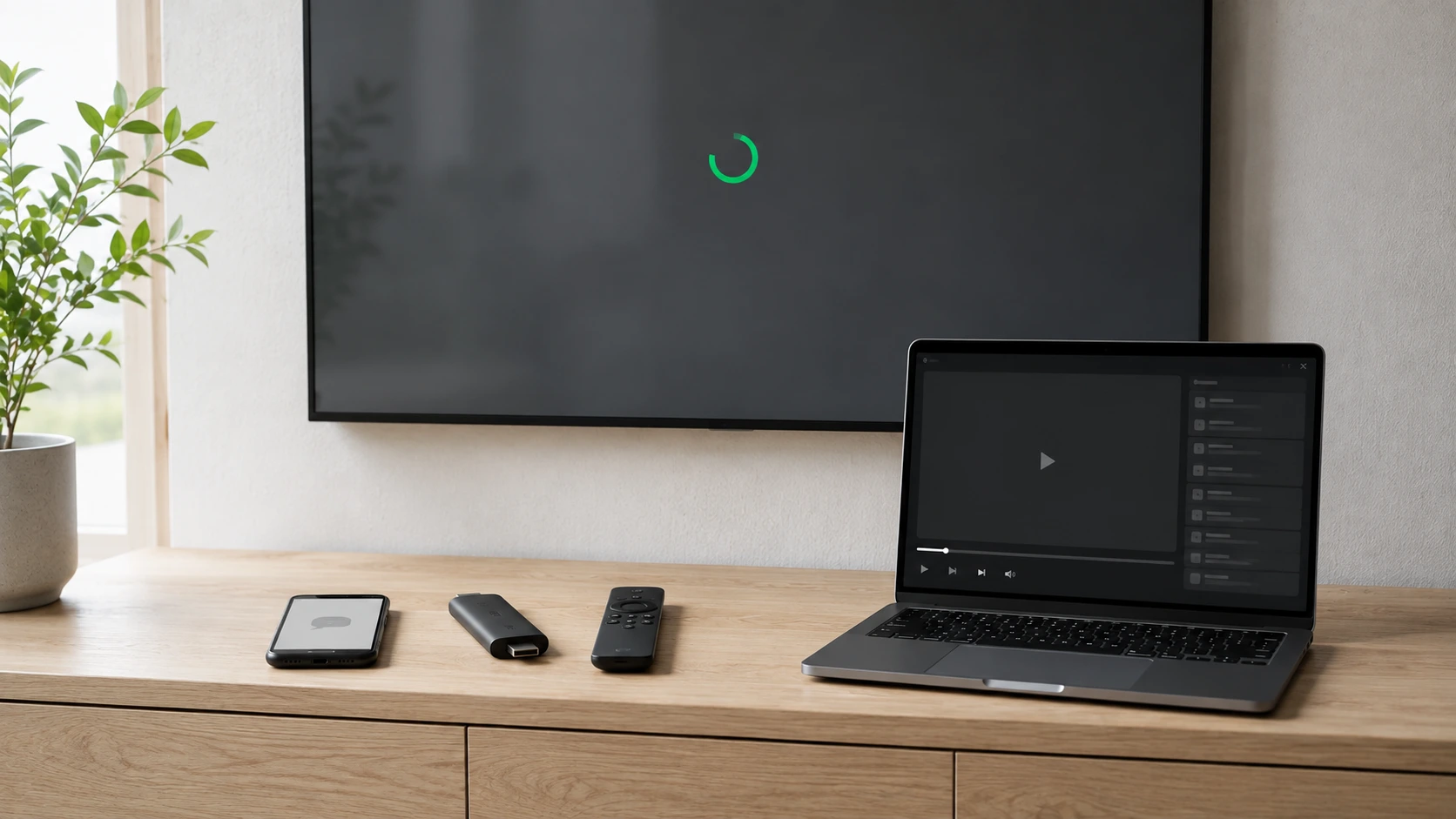
Almost anything with a screen works: Samsung Tizen and LG webOS smart TVs, Android TV and Google TV devices, the Amazon Fire TV Stick, Apple TV, iOS and Android phones and tablets, and Windows and Mac computers. The details are on the supported devices page. An older television without smart features is not a barrier — an inexpensive streaming stick makes it compatible for less than one month's subscription.
Among apps, IPTV Smarters Pro, IBO Player and TiviMate are the most common, with Smart IPTV and XCIPTV also widely used. The first is the usual starting point and also the one with the most modified builds in circulation, so learning to identify the genuine app is worth the five minutes before you install anything.
| Term | What it actually means |
|---|---|
| EPG | Electronic programme guide — what is on now and later |
| Catch-up | Watching a programme after it has aired |
| VOD | Video on demand — films and series, as distinct from live channels |
| M3U | A playlist format some providers use to deliver the channel list |
| Xtream Codes | A common login method: username, password and server address |
| DVB-T2 | The terrestrial standard Finnish HD broadcasts require |
Getting set up
The process is straightforward and usually takes a few minutes end to end.
- Pick a short period first. If you are unsure, start with one month — the annual plan can come later and your credentials carry over.
- Credentials arrive by message. Activation typically takes about a minute.
- Install the app from the developer's own site or an official store, not from a forum link.
- Enter the credentials once. The app fetches the channel list and the guide itself.
- Test before you commit. Watch one match or film all the way through and see how it behaves at peak time on your connection.
Step five matters most, and it is why we offer a trial at all. Quality depends on your network and your hardware, and no brochure can tell you that. What the service includes is set out on its own page: more than 18,000 live channels plus over 40,000 films and 12,000 series, in 4K and FHD where the source provides it, with a full EPG and catch-up.
The Finnish TV year, and when to start
Finnish viewing is not evenly spread across the year. It concentrates heavily in the dark months and around sport seasons, which is worth knowing because it decides when a subscription earns its keep.
The domestic Liiga hockey season runs from September to April, and the NHL season from October to June — the latter followed unusually closely here because of the number of Finnish players. Between them they anchor most sports viewing, and they fall exactly when evenings are dark and people are indoors. November to January is the peak: darkness, Christmas and holidays push screen time to its annual high.
May is its own event. The Ice Hockey World Championship is the single largest television moment of the Finnish year, and it is also when channel questions get sharp — that is the week people discover the match they wanted is on a service they do not have. Summer is quieter, and June to August is a good window to test a service without pressure.
The practical advice follows directly: if you are considering a subscription, start with a short period before a season begins rather than in the middle of one. You get time to test quality on your own connection, and if something needs fixing you fix it before the match you cared about is already running.
Five common mistakes
These recur regardless of which service a household picks.
- Committing to a fixed term at the start of a season. Enthusiasm peaks exactly when the contract is longest. If rights move mid-season, the contract stays and the content leaves.
- Not calculating the total. A single monthly price always looks small. Only all the lines together — Yle tax, operator TV component, streaming subscriptions — show the real figure.
- Mistaking a Wi-Fi problem for a service problem. A stuttering picture on fast fibre is almost always the home network. An Ethernet cable usually settles it in a minute.
- Installing the app from the wrong place. Modified builds of the popular players circulate widely. Use the developer's site or an official store, never a forum or chat link.
- Paying before testing. Quality depends on your network and hardware. A service that will not let you try it first is asking for trust while offering none.
The first four are cheap to fix afterwards. The fifth is not, which is why it belongs first.
Who it suits, and who it does not
The honest answer depends on what is fixed in your viewing and what moves.
It suits you if you want television separated from your broadband contract, you move between two addresses, you spend long stretches abroad, you want content no Finnish package carries, or you would rather avoid fixed-term commitments. For most internationals in Finland the fourth reason is the decisive one — it is not about paying less, it is about the content existing at all.
It does not suit you if you mainly watch Finland's free domestic channels, which the aerial already delivers and the Yle tax has already paid for. It also does not replace a specific exclusive when the competition you want sits behind one particular service — rights are national and time-limited and they move, as the Nordic rights reshuffle shows.
A combination is the usual outcome, and there is nothing wrong with that. The aerial handles the free domestic channels; a separate subscription covers what it does not.
The clearest single example of what the aerial does not cover is language. Not one Swedish channel appears on the mainland Finnish terrestrial network, even though the country has more than 285,000 Swedish-speaking residents. SVT and TV4 channels have to be bought as a paid operator add-on — Telia's Europe package at €9.10 a month on a Telia Play box, or DNA Norra at €10.07 a month on top of the mandatory DNA TV service, which pushes the real monthly cost past €19. For a Swedish-speaking or bilingual household the aerial is therefore not even a partial answer, and the options for Swedish-language viewing are worth going through separately. Prices checked 12 Sep 2026.
We do not claim to replace every channel a viewer in Finland might want, and we are not the official rights holder for any particular competition here. Who we are is stated openly, the FAQ covers the usual uncertainties, and if something is unclear, ask before you pay. How to read what other people say about any service is its own subject, covered in our article on reviews.
Summary
IPTV in Finland comes down to one thing: television is detached from the line and the address and attached to credentials instead. The technology is the same one Yle Areena and the operators use — the difference is what the viewing is tied to and what the line-up contains.
Two structural changes are in motion. Terrestrial licences are being redealt for 11 January 2027 to 10 January 2037, with the largest broadcasters applying, so what the aerial carries for the next decade is being decided now. And Yle's funding falls by €66 million in 2027, affecting both programming and staffing while the tax that funds it stays compulsory.
The practical instruction is short. Write down what television actually costs your household across all three layers. Then check which part of that total is tied to an address, a broadband line or a fixed term. That is the part that will cause trouble the next time something changes — and on this year's evidence, things change.
To compare options with the numbers in front of you, see the plans and monthly prices. To test the quality on your own device and connection first, start a free trial.