Best IPTV Service in Finland 2026: How to Actually Choose
The best IPTV service is not the one with the most channels. Choose on criteria that survive a cost review — and know what Finns are cancelling.
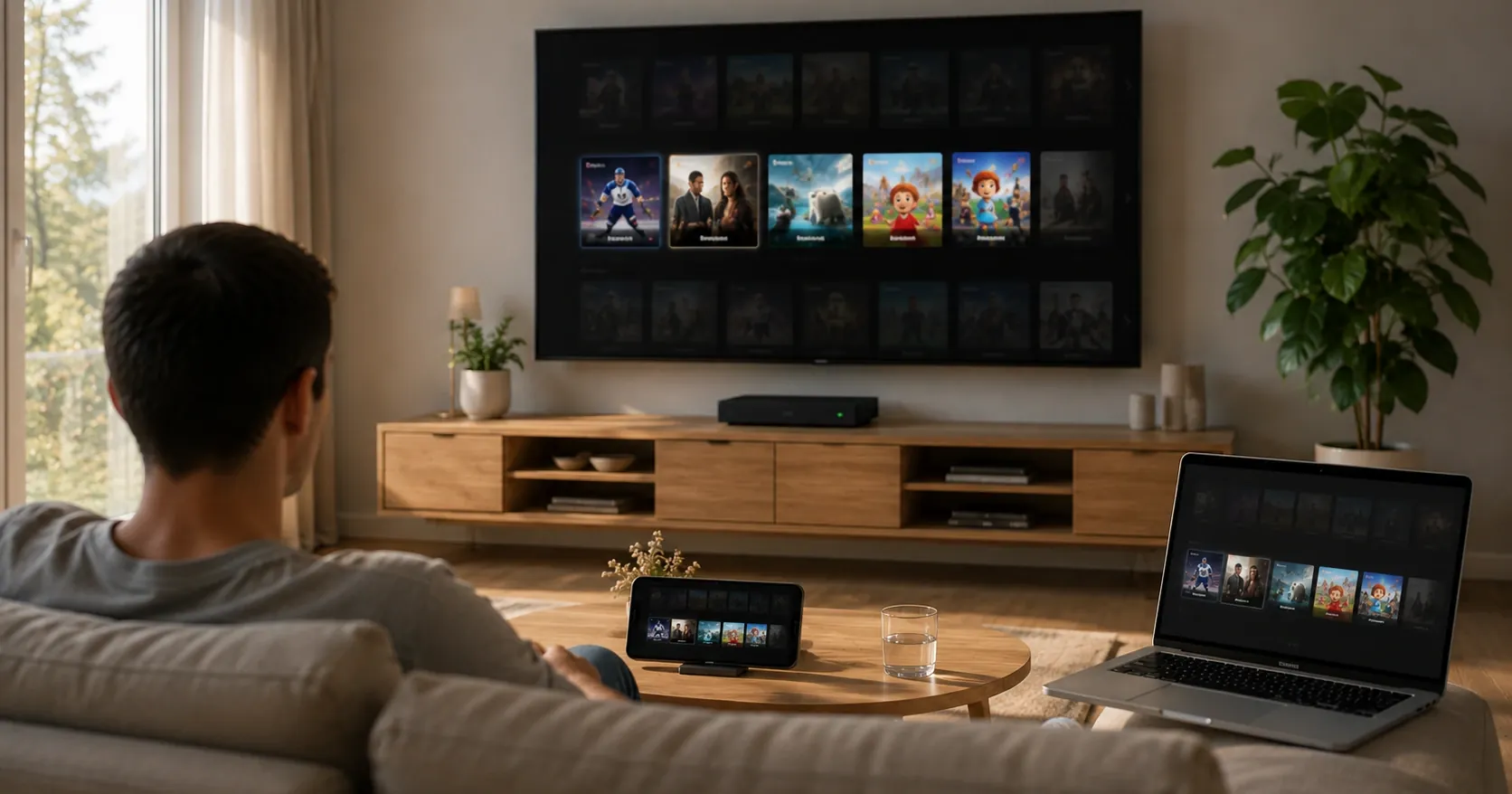
Most pages answering "best IPTV service in Finland" give you a numbered list. This one does not, for two reasons.
The first is honesty: we are an IPTV service ourselves, so we are not a neutral judge of competitors, and we cannot verify their contracts any more than you can. The second is more interesting. Finns have been cancelling services at an unusual rate over the past year, which means the useful question is no longer which service is best but which one survives a cost review. This article gives you the criteria to decide that yourself. Information checked 26 August 2026.
Why "the best IPTV service" is the wrong question
The question assumes services can be ranked absolutely. They cannot, because they solve different problems.
For a household following ice hockey and football, what matters is which service carries the matches this season — not the channel count or the picture quality. For one watching films and series, what matters is library depth and what is subtitled. For someone who moved to Finland, what usually matters is whether channels from home are available at all — a question of availability, not price.
Those three households reach different answers and all three are right. "Best" is always "best for something", and the something has to be defined first.
There is also a timing problem. Broadcasting rights are national and time-limited, and they move mid-season. A service that is right this year for a sports viewer can be the wrong choice next year without anything changing inside the service itself. That is a structural feature of the market, covered in the Nordic rights reshuffle.
Three questions that replace it
If "which is best" produces nothing usable, three narrower questions do.
What did I actually watch last month? Not what I could watch — what was watched. That list is almost always shorter than people expect, and it is the only measure that describes your household.
What am I paying for it in total? All three cost layers added together, not one service's monthly price. Only that figure shows whether there is any financial case for changing.
How quickly can I get out if I was wrong? The most underrated of the three. When rights move annually, the chance of a choice going stale mid-contract is not small.
These produce a concrete answer where "best service" does not. They also reveal quickly when there is no case for changing at all — a perfectly good outcome.
Finns are voting with their wallets
What follows is the part that has gone largely unreported, and it reframes the whole question.
According to an Iro Research study for POP Pankki, 24% of Finns dropped at least one streaming service in the past year, mainly for financial reasons. The more telling figure is the second one: 42% of Finns spend nothing on streaming at all.
The survey ran 16–24 September 2025 with 1,000 respondents, weighted to the population by age, gender, location and region, with a margin of error of at most ±3.2 percentage points.
Read those numbers alongside what was happening to prices. Streaming prices in Finland have risen repeatedly, with production costs and rights costs given as the reasons. When prices rise and content fragments across several subscriptions, households eventually start cutting. According to this study that point has now been reached in a quarter of Finnish homes.
The youngest cancel the most
One finding inverts the usual assumption.
You might expect the people dropping streaming to be those who barely use it — older age groups. The study found the opposite. 37% of both 18–24s and 25–34s had cancelled at least one service, against 32% of 35–44s.
At the same time younger people use these services most: 39% of 18–24s spend nothing on streaming, against 59% of those aged 65 and over.
Together these say this is not lost interest but price awareness. The youngest group both uses the most and switches most readily. They are not stopping watching — they are stopping paying for a service that is not currently earning its place. That behaviour rewards uncommitted subscriptions and punishes fixed terms.
Why prices keep rising, and what it means for choosing
Those cancellation figures do not arise in a vacuum. They answer a price trend that has run in the same direction for several years.
Streaming prices in Finland have risen repeatedly, with consistent justifications: content production is getting more expensive and rights for popular titles cost more. Nothing suggests this is ending. The same pressure shows on the operator side, where TV components have risen alongside broadband contracts.
For a viewer, though, what matters is not any single price but two structural consequences.
Overlap. When every service raises its price separately, a household subscribing to four experiences four increases a year. None feels large alone, but together they explain why a quarter of Finns have cut something.
The cost of commitment. A fixed term protects you from increases for its duration, which sounds good. It also prevents you reacting when the content changes or your own viewing changes. In a rising-price environment these two effects cancel each other out more often than people expect.
The practical conclusion is to compare annually rather than monthly, and to include what it would cost to get out if the choice proves wrong. A monthly price without an exit cost is half a number.
Prices change quickly — always confirm current pricing directly with the provider before ordering. Information checked 26 August 2026.
Work out what you pay now
Before comparing any service to another, do the calculation almost nobody does. It changes the question entirely.
Finnish household TV costs sit in three layers, and only one is clearly visible each month.
| Layer | Item | Visible separately? |
|---|---|---|
| 1 | Yle tax | No — collected through taxation |
| 2 | Broadband TV component | Rarely — inside the connection bill |
| 2 | Building cable TV | No — inside the maintenance charge |
| 3 | Streaming subscriptions | Yes — but on different days, different cards |
Write every line down and add them up. Two things surface almost every time. The total is larger than expected, because two of the three layers never appear as a distinct monthly charge. And much of the total is fixed — the Yle tax cannot be opted out of, and a TV component bundled into broadband usually cannot be removed without changing the whole connection.
That changes the question. It is not whether some service is cheap, but which part of your current bill is genuinely changeable. That part is usually smaller than marketing implies, and it is the only part worth comparing a new service against.

What "best" means in practice: four criteria
Once you know the total, the choice comes down to four criteria, best taken in this order because each narrows the next.
1. Content — what you actually watch. Write down the five or ten things your household really watches. Not what it could watch, but what it watched last month. That list is the only relevant measure, and it is nearly always far shorter than people guess.
2. Commitment — how expensive being wrong is. A fixed term is cheaper monthly but binds you when content changes. A per-period arrangement costs more monthly and less when you were wrong. With rights moving annually, this is not a minor detail.
3. Devices — does it work on what you own. Does it need an operator box, or does it run on the television, stick or phone you already have? A box purchase is a real cost that usually escapes comparisons.
4. Support — does anyone answer when something breaks. Channel changes and app problems reach everyone. The difference is not whether problems occur but how fast they are answered, and in which language.
Two things are deliberately outside that list, and they are the two marketing emphasises most: channel count and picture quality. Both are self-reported figures nobody audits.
Why channel count is the worst single measure
The number appears in every comparison and deserves its own note, because it carries the most weight and the least information.
There is no standard counting method. The same channel in different quality versions can be counted repeatedly, regional variants are counted separately, and totals typically include many channels nobody in Finland watches. The figure grows without the offering improving.
The comparison also misleads in the other direction. Households watch a handful of channels regularly. Whether a line-up holds 18,000 or 46,000 changes nothing about daily life if the five or ten you actually watch are missing or unreliable.
The useful question is different: do the channels I watch work, on my device, on my connection. No brochure figure answers that — only a trial does, and that applies to our own number as much as anyone's.
Sport is the hardest case
If your household follows sport, the choice is markedly harder — and the reason is structural rather than about any particular service.
Sports rights are sold by sport, by competition and by country, and the contract periods end at different times. One household can end up tracking three or four separate negotiations to know where its sport will be next season. Few people do, which is why a season often begins with the discovery that the match you wanted is on a service you do not have.
The 2026 picture illustrates this well. Viaplay consolidated its sports branding in August 2025, when the former V sport Suomi channels moved under the Viaplay Urheilu name. Streaming subscribers gained the ability to watch the group's linear pay-TV channels directly in the app, and Viaplay Total customers get seven sports channels. Premier League coverage in Finland sits with Viaplay until at least 2028, after which the contract is open again.
Two pieces of advice follow for sports viewers, and they differ from the rest of this article.
Do not pick a service for one competition and commit for long. That is precisely where a fixed term becomes expensive: the rights move, the contract stays.
Check renewal dates before committing. If your sport's contract period ends next year, do not sign a two-year deal on the strength of it.
Sport is also the category where a trial should be timed to the season rather than the summer break — a live broadcast at peak time is the only test that tells you anything.
Three common mistakes
These recur regardless of which service a household picks.
1. Comparing a monthly price instead of the total cost. A single monthly price always looks small, which is exactly how four of them accumulate. Comparison only becomes meaningful once all three layers are added and you know which part is genuinely changeable.
2. Committing at the start of a season, when enthusiasm peaks. Sports seasons and darkening autumns encourage long contracts exactly when the need feels greatest. If rights move mid-season or viewing drops off in spring, the contract stays and the benefit goes.
3. Believing brochure figures instead of testing. Channel counts, picture quality and server promises are all self-declared. The only measure that says anything about your household is a trial on your own device and connection.
4. Ignoring overlap entirely. Two broad film and series libraries contain more of the same than people assume, and the overlap grows as services license the same titles. Before adding a third subscription, check how much of your watchlist already exists in the two you have.
The first three are cheap to fix afterwards if the contract has no fixed term. The last is not, because you only notice it after paying — which is why it belongs first.
How to test before committing
Criteria stay theoretical until tested. Do it in this order.
Watch one complete thing. Not a few minutes — one match or film all the way through. Problems rarely appear in the first five minutes.
Test at peak time. A weekday evening at 20:00, or a match night, tells you far more than a Tuesday morning.
Test on the device you actually use. A service working on a phone proves nothing about the living-room television.
Check the five things on your list. Go back to criterion 1 and see whether they are there. That is the whole point of the test.
Ask support something before paying. Response speed before purchase is the best available predictor of response speed after it.
If the test goes badly
A failed trial is a useful result, provided you read the right thing from it. Not every problem is about the service.
If the picture stutters, test the same content on another device and over Ethernet before drawing conclusions. Home Wi-Fi is by far the most common cause, and it follows you from service to service. Switching because of a Wi-Fi problem just reproduces the problem with a new bill.
If the channels you wanted are missing, that is directly relevant and exactly what the test was for. The answer is clear and needs no further investigation.
If the app feels clumsy but the content is right, remember that app and service are two separate decisions. Most credential-based services work with several player apps, so the interface can change without touching the subscription.
And if support did not answer during the trial, that is a forecast rather than an accident.
How to read other people's reviews in this context is its own subject — our article on reviews explains why they are unusually unreliable in this category. If you are considering an unfamiliar brand, checking its background is worth doing before paying.
The best IPTV service in three typical situations
The criteria produce different answers for different households. Three common cases show how.
| Sports viewer | Films and series | Recently moved to Finland | |
|---|---|---|---|
| Decisive question | Where are the matches this season | Library depth and subtitles | Are home channels available at all |
| Biggest risk | Rights move mid-season | Paying for overlapping libraries | Content not offered at any price |
| Commitment | Avoid fixed terms | A fixed term can make sense | Avoid fixed terms |
| What to test | A live broadcast at peak time | Search and subtitles | The specific channels you want |
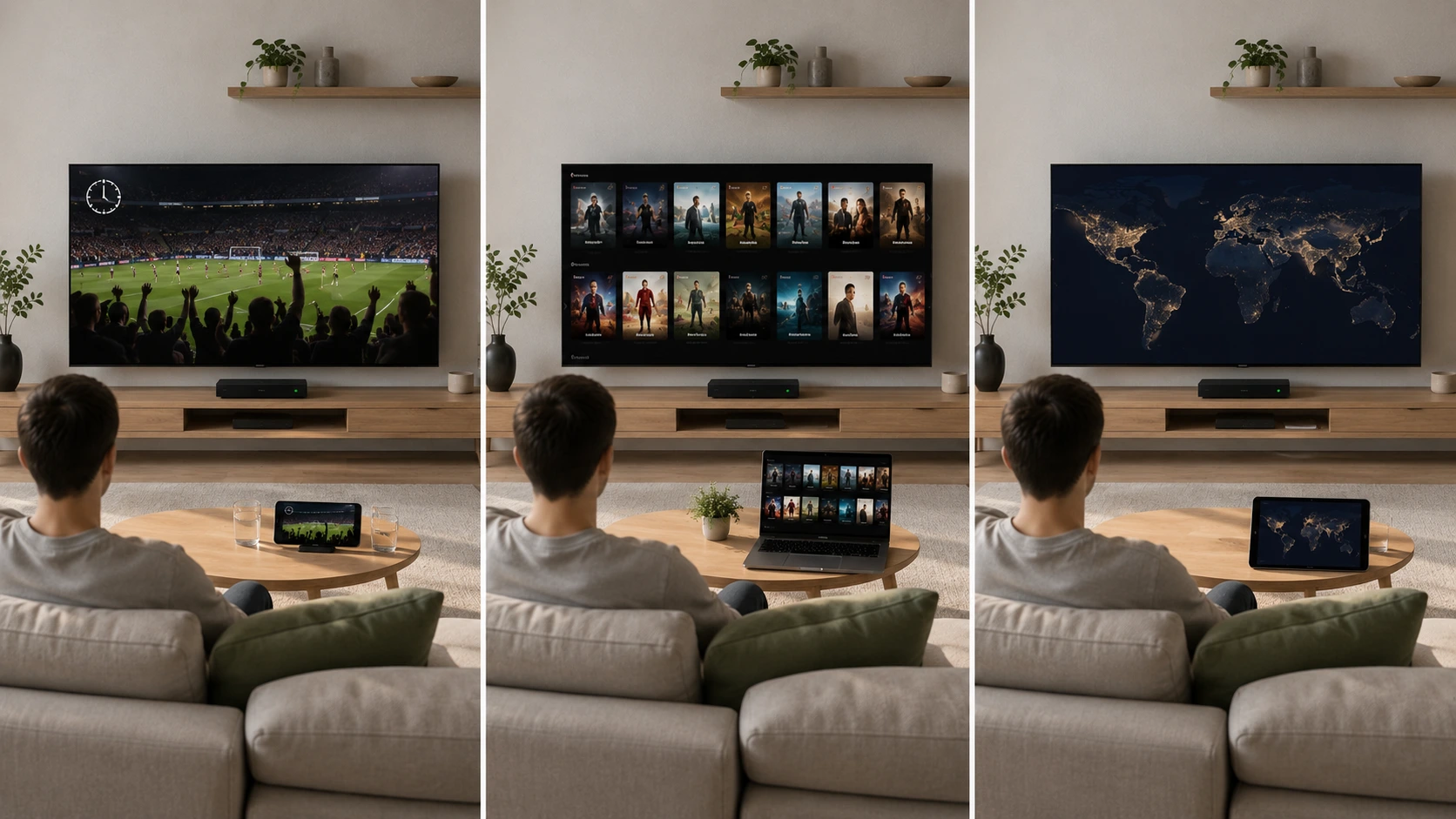
For a sports viewer, flexibility matters most because rights move. For a film watcher, overlap is the largest wasted cost. For someone who has recently moved here the question is often not price at all — Finnish operator packages are built for the domestic market and carry no other countries' channels at any tier.
What Nordic IPTV is — and what we do not claim
Since this is an IPTV service's own site, let us be explicit: we do not claim to be the best service. That claim would not be verifiable, and it is exactly the kind of promise this article tells you to distrust.
Nordic IPTV is a credential-based subscription. What the service includes is on its own page: more than 18,000 live channels plus over 40,000 films and 12,000 series, in 4K and FHD where the source provides it, with an EPG and catch-up. Supported devices cover smart TVs, Android TV, the Fire TV Stick, Apple devices, computers and phones — no operator box required.
Pricing is public: €15 for one month, €35 for three, €45 for six and €65 for twelve — about €5.40 a month annually. Streams run from two to five depending on the plan, every plan is billed once with no automatic renewal, there is no fixed term, and each carries a 7-day money-back guarantee.
Where we land on these criteria: well on commitment and device freedom, since there is no fixed term and no box. On content it depends entirely on what is on your list — we do not claim to replace every channel and we are not the official rights holder for any competition in Finland. That is exactly why we ask people to test before paying rather than to believe figures.
Who we are is stated openly, and the FAQ covers the usual uncertainties. The wider picture of Finnish television and its costs is in our guide to IPTV in Finland.
Summary
The best IPTV service is not the one with the most channels. It is the one that covers what your household actually watches, binds you for the shortest time, works on hardware you already own, and answers when something goes wrong.
Finns have already started choosing on that logic. A quarter cancelled at least one streaming service in the past year and 42% pay for none at all — and cancellation is most common in the youngest groups, who use these services most. That is not lost interest; it is a sign that being uncommitted has become a selection criterion.
The practical instruction has three steps. Write down the five things you actually watch. Add up what television costs you across all three layers. Then test before committing to anything — on your own device, your own connection, at peak time.
To compare options with the numbers in front of you, see the plans and monthly prices. To test the quality first, start a free trial.