Best IPTV 2026: How to Read the Lists After Google's Change
Best IPTV lists rarely say who tested what. On 28 Aug 2026 Google changed how it treats borrowed domains in Europe — here is how to read a list.
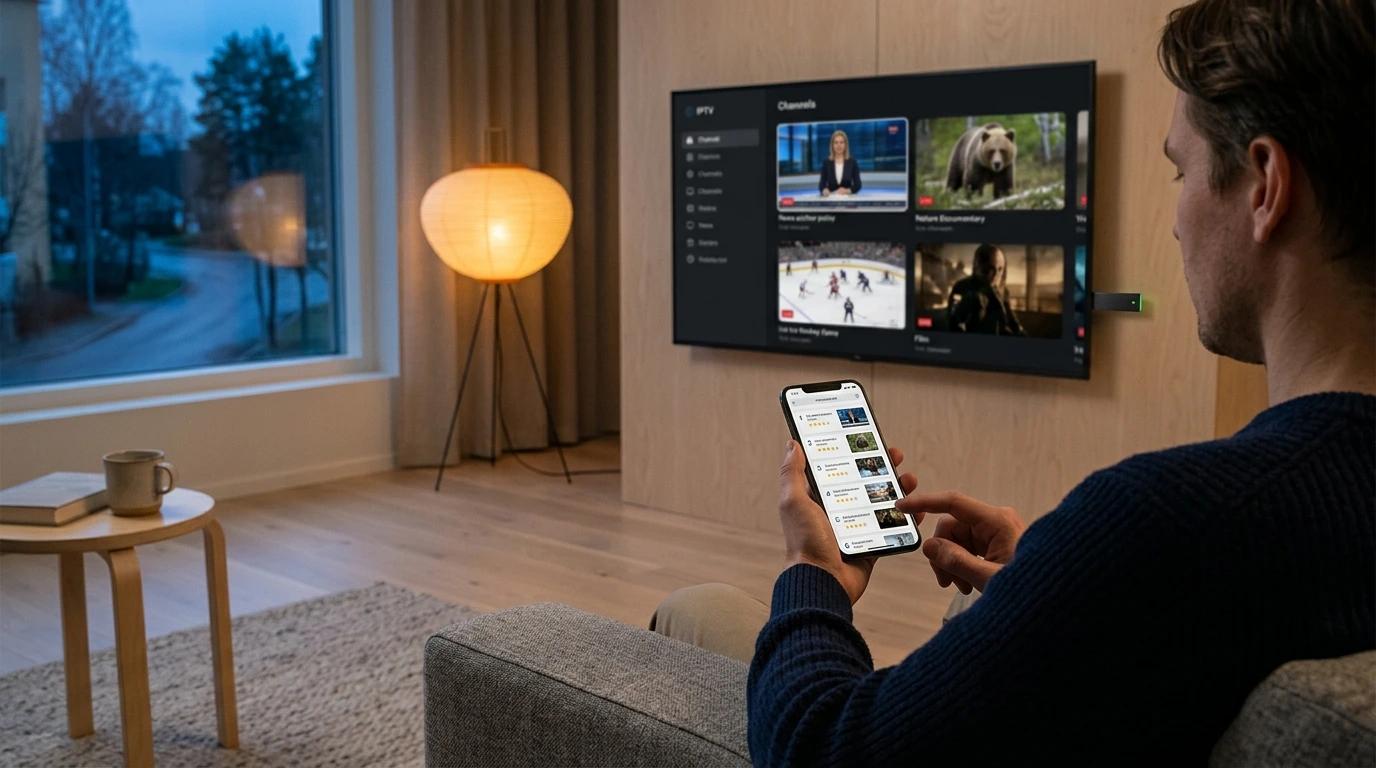
Best IPTV is the search many people in Finland start with when looking for an IPTV service — usually in English, because Finnish-language comparisons are scarce. It returns dozens of ranking lists promising to name the best service. Very few say who tested, when, or how.
In late August 2026 that picture shifted. Google changed how it handles pages published on borrowed domains inside the European Economic Area — the exact pattern many best IPTV lists rely on. Behind the change is a European Commission investigation the Commission aims to conclude by November 2026. This article covers what changed, why the same search can look different in different countries, and how to read a list so it is actually useful. Information checked 15 Sep 2026.
What a "best IPTV" search actually returns
A handful of page types dominate. The most common is a ranking list headlined "top 10 IPTV services" or "tested and ranked". Then come star-rated comparison tables, provider pages dressed up as neutral comparisons, and English-language guides written for American or British readers.
They share one feature: the address bar shows you the site, not the author. When we went through best IPTV search results on 15 September 2026, borrowed platforms turned up quickly:
- a list on a free website builder whose domain belongs to a large technology company
- promotional IPTV text on a profile page of a university's open online platform
- a user post on a community for startup founders — already deleted when we opened it
- a blog section on a subdomain of a major news publisher's domain
From the address alone you cannot tell who wrote any of these, or whether the platform ever reviewed them.
That does not make every IPTV list a scam. It means a domain's reputation says nothing about an IPTV list's quality — which is why August's change matters to an ordinary searcher. If IPTV itself is new to you, start with the IPTV Finland guide; this article is about reading IPTV lists.
August 2026: Google changed how it enforces the rules in Europe
Google's spam policies include a section on site reputation abuse. According to Google's policy page, it covers third-party content published on a host site mainly because of that host's already-established ranking signals, earned primarily from its own first-party content.
Google's own example could have been written about IPTV lists: a medical site hosting a low-quality, third-party advertising page about "best casinos". Same structure — a trusted name, someone else's content, a ranking headline.
What the rule does not cover matters just as much. Google excludes wire services and press-release sites, syndicated news, user-generated content such as forums, columns and other editorial work, and third-party content with clear editorial responsibility and properly marked affiliate links. Plenty of best IPTV lists sit in areas the rule never tries to police.
On 28 August 2026 Google updated the policy, and enforcement split in two:
| Inside the EEA | Outside the EEA | |
|---|---|---|
| Manual action | not used | possible when the page appears to users outside the EEA |
| What happens instead | the page may be categorised as separate from the main domain | the page can be demoted by a manual action |
| Effect | that section ranks independently of the rest of the site | its ranking can fall, or it can drop out of results |
In practice, a section breaking the rule in Europe no longer receives a human-issued penalty; Google's systems try to separate it from its host so it stops borrowing the host's reputation. The difference is technical, but it has a consequence: the same page can be treated differently depending on where the searcher is.
Why the European Commission got involved
The change did not come from nowhere. On 13 November 2025 the European Commission opened proceedings to assess whether Google breaches the Digital Markets Act (DMA) in how it applies its site reputation abuse policy.
According to the Commission's press release, its monitoring showed indications that Google demotes news media and other publishers in search results when their sites include content from commercial partners — which, the Commission said, appears to hit a common and legitimate way for publishers to monetise. The case rests on Articles 6(12) and 6(5) of the DMA, which require transparent, fair and non-discriminatory conditions for Google Search's ranking.
One detail stands out for Finnish readers: among those backing the investigation was Henna Virkkunen, the Commission's Executive Vice-President for Tech Sovereignty, Security and Democracy. In her words, the investigation "aims to protect publishers' funding, their freedom to conduct business and ultimately media pluralism and our democracy."
The timetable and stakes are clear:
- the Commission aims to conclude within 12 months of opening the proceedings
- an infringement can bring fines of up to 10% of worldwide turnover, and up to 20% for repeated infringement
- opening proceedings does not itself mean an infringement has been found
According to Google, the August change followed discussions with the Commission. From a consumer's point of view, two legitimate interests collide: publishers' right to fund themselves with partner content, and searchers' right not to be misled by borrowed reputation. The dispute is not about IPTV — but IPTV lists live precisely in that gap.
Where best IPTV lists come from
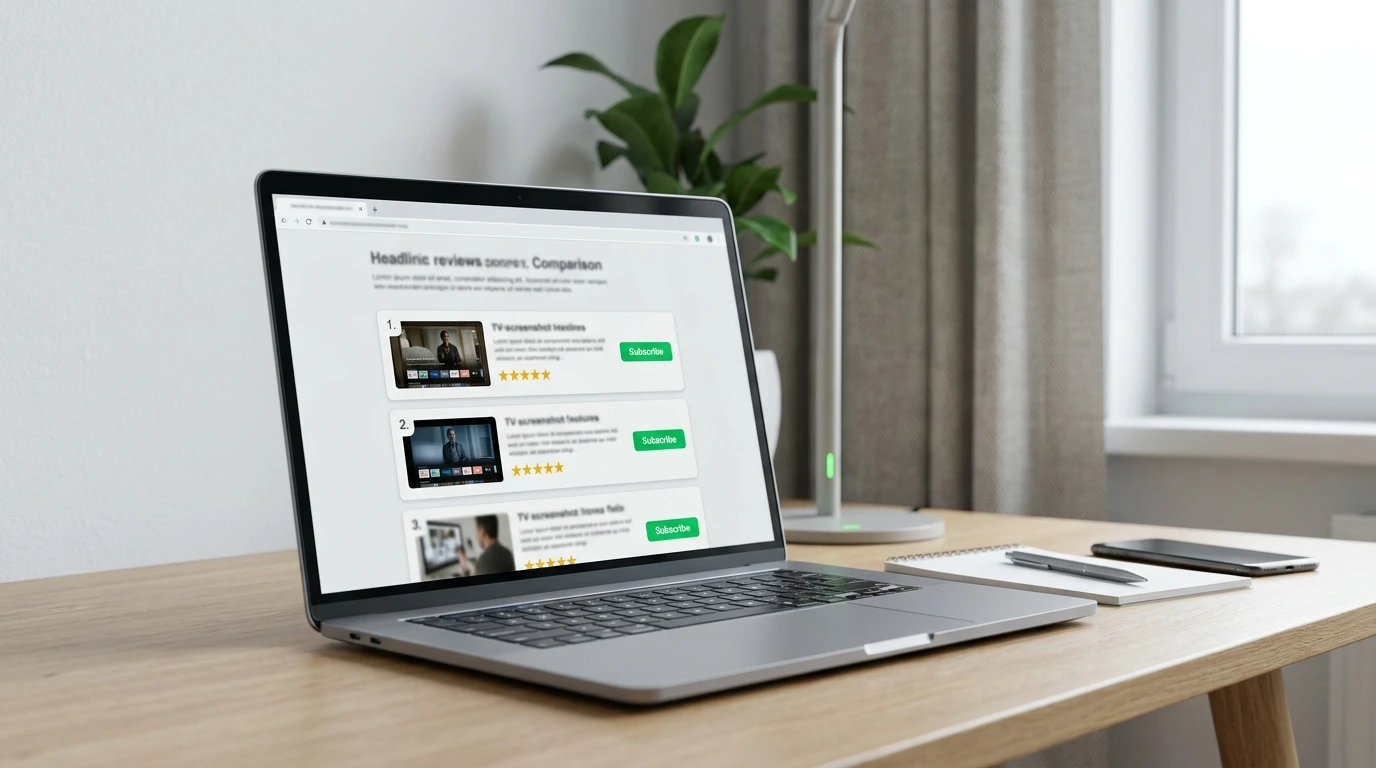
IPTV lists make sense once you see how they earn money. The usual model is an affiliate commission: the writer is paid for each subscription made through the list's links. That is legal when the commercial relationship is clearly marked, but it steers the order. The top spot easily goes to whichever service pays best, not whichever works best.
A second model is reselling: one service sold under several names, with a reseller publishing a list topped by its own brand. A third is plain search optimisation: the same text copied to a dozen platforms with small changes, in the hope that one of them ranks.
| List type | What it looks like | What it usually leaves out |
|---|---|---|
| Affiliate list | a thorough comparison | who pays the commission, and how much |
| Reseller list | a neutral test | that the top brand belongs to the writer |
| List on a borrowed platform | content from a well-known site | who actually wrote it |
| Foreign guide | current and in-depth | that its channel line-up does not apply to Finland |
What they share is that a test is mentioned but never described. "We tested 30 services" is a claim that would need a date, a device, a connection, a viewing duration and a time of day to check. Without those, a reader cannot tell a test from an opinion.
Same search, different results in Finland and the US
The most practical consequence of August's change is this: a searcher in Finland and one in the US may not see the same page treated the same way. Under Google's policy, manual actions apply to pages as they appear to users outside the EEA, while inside the EEA the same page is handled by separating it from its host.
The EEA covers every EU country plus Iceland, Norway and Liechtenstein. Across the Nordics the handling is therefore the same in Finland, Sweden, Norway and Denmark — and different from the US and the UK, where most English-language IPTV guides are written.
Two everyday consequences follow.
A screenshot of search results in a foreign guide does not show your results. If a British guide says a site has been "removed from Google", it may still appear to someone searching from Finland.
An English-language list is written for an English-language market. Its channel line-ups, sports leagues and prices apply to the US or the UK. The questions that matter to a household in Finland — domestic channels, Liiga, what Yle Areena already offers, and what the current Elisa Viihde, Telia or DNA package costs — usually do not appear at all.
A sensible rule of thumb: treat a foreign best IPTV list at most as a catalogue of services that exist, not as an answer to what suits Finland.
Seven signs that show whether a list can be trusted
You do not have to discard an IPTV list, but you can check it. These seven signs separate a described test from an advert.
| # | Good sign | Warning sign |
|---|---|---|
| 1 | The author is named and reachable | No name, or the same text on several platforms |
| 2 | The test date is given | "2026" in the headline, no date in the text |
| 3 | The method is described: device, connection, duration, time of day | "We tested them all" with no detail |
| 4 | Affiliate links are marked | Every link goes to a checkout with no disclosure |
| 5 | Prices are dated | A price with no date or currency |
| 6 | Channels are described in general terms | Named premium channels and leagues at a fixed price |
| 7 | Recommended apps are still available | Apps already removed from the app stores |
Sign 7 is the easiest to check and says the most about a list's age. In spring 2026 36 IPTV player apps were removed from the app stores, and many IPTV lists still recommend them. An IPTV list not updated since the app stores changed has probably not been updated in any other respect either.
A worked example
Picture a typical best IPTV list headlined "10 Best IPTV Services 2026 — Tested and Ranked". No author is named, and the opening claims "we tested dozens of services". There is no test date, prices appear without one, and every entry has a subscribe button with nothing said about commission. The top pick promises Finnish channels and Liiga at a fixed monthly price, and the setup guide recommends an app pulled from the app stores in spring.
That IPTV list fails all seven signs. It does not prove the services on it are bad — it proves the list cannot tell you anything about them. Compare a ranking list that names its author, gives a test date and device, and marks its affiliate links: it may still be wrong, but its claims can be checked, and that is what makes a best IPTV list usable at all.
Signs 1 and 4 are the ones August's change touches most directly: Google's own line runs exactly along clear editorial responsibility and marked affiliate links. Individual reviews are a different genre, covered in our article on reading IPTV reviews — lists and reviews need to be read differently.
What Finnish-language lists promise — and why that is a problem
Finnish-language best IPTV comparisons are fewer than English ones, and their promises tend to be bigger. Headlines in Finnish-language search results on 15 September 2026 included promises of "over 37,000 channels and 4K quality" and "Yle, MTV3 and Liiga from €29".
Both headlines reveal something — just not what they claim.
A channel count is not a quality measure. Most very large counts are foreign channels a Finnish household never opens. The figure describes the length of a list, not whether a match stream holds up on a Saturday night.
Named channels and leagues at a fixed price are a rights claim. Broadcast rights to leagues like Liiga are sold in Finland under contracts to specific companies. Yle, meanwhile, is available on Yle Areena at no extra charge because it is already funded by the Yle tax. A headline selling a named league and domestic channels in one price bundle is making a statement about rights — and a reader should ask on what basis.
It is also why we do not promise named premium channels or leagues ourselves. The difference between licensed retransmission and unlicensed streams is covered in our article on IPTV legality in Finland. In short, a top spot on a list says nothing about legality, because a ranking is marketing, not an official assessment. In Finland, Traficom supervises communications networks, TTVK provides copyright information and the Finnish Competition and Consumer Authority handles consumer rights.
From a list to a shortlist: three checks before a trial

Once you have read an IPTV list, take at most three candidates and check three things about each — outside the list. It takes fifteen minutes and can save a month's bill.
1. Who is behind the service. Are there contact details, public terms and a refund policy? Do they say what happens if the service does not work? Our own terms of service can be read before ordering, and any serious provider's terms should be just as available. For an unfamiliar brand, checking its background is worth doing before you pay.
2. Whether it works on your device. Lists rarely say what they tested on. Check the provider's own device support and whether a separate app is needed. Nordic IPTV's supported devices include smart TVs, Android TV, Fire TV Stick, Apple devices, computers and phones.
3. What the total price includes. Beyond the monthly price, check the contract length, automatic renewal and the number of simultaneous streams. The cheapest monthly price can turn out the most expensive if it locks you in for a year. For comparison, Nordic IPTV's prices are public, and no plan has a fixed-term contract.
If a candidate fails any of the three, it drops off your shortlist, whatever position it held on the ranking.
The best IPTV for your household: a list versus a test
A ranking list answers someone else's question about someone else's household. A useful "best" only appears once the question is your own.
| A list tells you | Your own test tells you |
|---|---|
| which services exist | whether the service works on your TV |
| what the writer values | whether it holds up on your connection at peak time |
| what pays the writer a commission | whether it has what your household actually watches |
| how things looked on publication day | how things look today |
That is why we do not repeat selection criteria or a testing routine here. They are covered in full in our guide to choosing the best IPTV service and testing it step by step. This article's job is narrower: to help separate a list worth giving weight from one that is not.
One number is still worth remembering, because lists often leave it out: we recommend at least 15 Mbit/s for HD and 25 Mbit/s for 4K. A Finnish fibre or 5G home connection handles this comfortably.
What Nordic IPTV is, and what we don't claim
For clarity: Nordic IPTV is a credentials-based IPTV subscription for the Finnish market, sold over WhatsApp.
We offer 18,000+ live channels, 40,000+ movies and 12,000+ series, 4K and FHD where available, EPG and catch-up, activation in about a minute, round-the-clock WhatsApp support and a 7-day money-back guarantee. Plans are €15 / 1 month, €35 / 3 months, €45 / 6 months and €65 / 12 months, with 2–5 simultaneous streams depending on the plan.
What we do not claim: that we are the best for everyone, because no such service exists. We do not promise named premium channels, leagues or specific broadcast rights. And if you see us on a best IPTV list, check that IPTV list for the same seven signs — the advice applies to us exactly as it does to anyone else.
What to watch next
Two things will be settled in the coming months, and either could change what a best IPTV search shows in Finland.
The outcome of the Commission's investigation. The Commission aims to conclude within 12 months of opening proceedings on 13 November 2025 — that is, by November 2026. If it finds evidence of non-compliance, it will first inform Alphabet of its preliminary findings and the measures it considers necessary. Google's EEA approach could change again.
How well Google's systems do the job. Instead of manual actions, the EEA now relies on systems separating third-party sections from their hosts over time. How quickly and accurately that works cannot be judged from under three weeks of experience.
Neither outcome changes one basic rule: the name in the address bar tells you where a text sits, not who wrote it. That holds however the Commission and Google eventually settle the matter.
Summary
A best IPTV search returns ranking lists that rarely name an author, a test date or a method, and some are published on borrowed domains. On 28 August 2026 Google changed how it handles such pages in the European Economic Area: rather than manual actions, pages can be separated from their host site. Behind the change is the European Commission's investigation opened on 13 November 2025, which the Commission aims to conclude by November 2026.
The practical conclusion has three parts. Read an IPTV list as a catalogue, not a verdict. Check the seven signs and three things outside the list. And make the final decision on a test run on your own TV.
If you want to run that test with our service, start with a free trial and look at the plans and prices at the same time. The fundamentals of IPTV in Finland are in the IPTV Finland pillar guide.