Viking IPTV and Nordic Brand Services 2026: What to Know
Viking IPTV is one of many Nordic IPTV brand names. How to tell these services apart — and what changed in Sweden in 2026.
If you have moved to Finland and discovered that no Finnish operator package carries a single channel from your home country, you have probably ended up searching for names like Viking IPTV. That search route is extremely common among internationals here, and it lands on a crowded, confusing category.
This article is not a review of one service. We do not know, and do not claim to know, what agreements any particular third-party provider holds, and we make no assertions about any named competitor. What we can do is describe the category honestly, give you a checklist for evaluating any provider — including us — and cover the most significant Nordic development of 2026, which went almost unreported in Finland. Information checked 26 August 2026.
What "Viking IPTV" means as a search term
Type a brand name plus "IPTV" into a search engine and the results look much the same whichever name you use. Sites promise tens of thousands of channels and hundreds of thousands of films, prices are a fraction of an operator package, and the same brand name appears on several different extensions — .fi, .com, .no, .us — with slightly different content and different contact details on each.
That repetition is itself information. It tells you this is a marketing model rather than a single company: one underlying technical service resold through many resellers under many brands, where the brand can change faster than the system behind it.
The practical consequence is that the brand name tells you very little. Two different names can be the same service, and the same name on two sites can be two different sellers. So direct your assessment at things you can verify — who owns the domain, whether an identifiable company exists, whether you can test before paying — rather than at how the name sounds or how many sites praise it.
Why unlicensed IPTV is growing in the Nordics
The question is a fair one, because the Nordics are the wrong place for this on almost every measure. Legal availability is broad, broadband is excellent, purchasing power is high and institutional trust is unusually strong. Growth is rapid anyway.
According to Mediavision's spring 2025 study, more than 1.5 million Nordic households subscribe to an unlicensed IPTV service — around 16% more than in spring 2024, meaning roughly 200,000 additional households in a single year. The study interviewed over 6,400 people aged 15–74 across Denmark, Finland, Norway and Sweden. Sweden, Denmark and Norway each show higher household penetration; Finland has the lowest share of the four, and Norway saw the largest year-on-year growth.
The explanation is economic rather than technical, and it has three parts.
Fragmentation. The content people want is split across several subscriptions — domestic channels one route, sport another, international drama a third, films a fourth. No single subscription covers what an ordinary household actually watches.
A compounding total. When every piece is priced separately, the combined bill grows unnoticed. In Finland the Yle tax sits on top, paid regardless of what you watch, plus an operator TV component that usually travels inside a broadband bill without being itemised.
Rights that move. Content changes service mid-contract. A household that chose its subscription for one competition finds itself the next season paying for a service that no longer carries it.
Together these produce a real frustration, which one cheap "everything included" service appears to answer perfectly. The promise lands precisely because the problem is genuine.
The arithmetic worth doing first
Before comparing any new service to your current setup, do one calculation almost nobody does.
Write down every television-related line: the Yle tax, the TV component of your broadband or your building's cable service, and each streaming subscription separately. Add them up. Only that figure is what television actually costs your household.
Two things surface almost every time. The total is larger than expected, because two of the three layers never appear as a distinct monthly charge. And a large share of it is fixed — the Yle tax cannot be opted out of, and a TV component bundled into broadband usually cannot be removed without changing the whole connection.
This matters because it changes the question. It is not whether some service is cheap; it is which part of your current bill is genuinely changeable. That part is usually much smaller than marketing implies — which is exactly why unrealistically cheap promises feel so appealing.
Sweden 2026: watching may become finable
This is the most important part of the article, and it changes an assumption that has held across the Nordics for as long as IPTV has existed.
Until now, enforcement has targeted providers. The viewer has been effectively outside the scope of action everywhere in the Nordics. Sweden is moving to change that.
An inquiry commissioned by the Ministry of Culture proposes that watching an unlicensed service should become punishable for a private individual. The penalty for consumers would be a fine, while those running the commercial operation face up to six years' imprisonment. The change has been proposed to enter into force on 1 July 2026.
The scale explains the pressure. More than 700,000 Swedish households — around 15% of the population — are estimated to use an unlicensed IPTV service, with an estimated annual loss of SEK 1–1.5 billion to broadcasters and rights holders. The reasoning is blunt: because providers often operate anonymously and from abroad, enforcement should also reach the end user.
Two clarifications are essential here.
This is a proposal, not law in force. Legislation can change, be delayed or fail. 1 July 2026 is a proposed commencement date, not an accomplished fact.
This is Sweden, not Finland. It has no direct effect on Finnish law whatsoever.
Nordicplay and how 4,886 subscribers were identified
The proposal did not appear from nowhere. Behind it is a concrete case that demonstrated subscribers can be identified — and that is the most instructive part of this article.
According to TorrentFreak's January 2026 report, Swedish authorities shut down an IPTV operation called Nordicplay. The suspects were a 43-year-old man and his 55-year-old business associate, and the operation's estimated revenue was around 35 million Swedish kronor.
The charges are telling. The men were not primarily charged with copyright offences but with gross accounting fraud — failing to report the proceeds to the tax authorities. This is typical: financial-crime charges are often easier to prove than copyright infringement and lead to the same practical outcome, the operation ending.
The decisive detail was on the devices. Investigators found over 20,000 contact records, and of those 4,886 subscribers could be identified as individuals.
Why the payment method is the decisive detail
The identification did not come from hacking or from monitoring network traffic. It came from payments.
A large share of subscribers had paid using Swish, the Swedish mobile payment system, which is tied directly to a personal identity number. A payment therefore leaves a trail leading to a name — not by the recipient's choice, but by the structure of the payment system.
There is a general lesson here that holds regardless of country or service. Viewers tend to think about anonymity from the viewing side: who can see what I watch. In practice identification happens almost always through payment, not viewing. A service with no identifiable company behind it is also a service whose customer database can end up in an investigation exactly as it stands.
Those 4,886 people are not currently facing prosecution. But lists like theirs are precisely what would become usable evidence if the proposal on viewing becomes law.
Does this affect Finland?
Not directly. That is worth stating plainly, because exaggerated versions of this circulate.
Swedish legislative work does not extend to Finland. Enforcement here has targeted, and continues to target, service providers, resellers and server infrastructure. TTVK's position is that action is directed at those supplying illegal services rather than individual households, and the practical instrument has been applying to a court for blocking orders.
What has actually happened in Finland
Finland's approach has been consistent, and knowing it puts the Swedish proposal in proportion.
The main instrument is the blocking order. A rightsholder, or TTVK acting for them, asks a court to require telecom operators to block access to an infringing service. The order is directed at the operator, not the viewer, and no notification reaches the viewer — the service simply stops working.
Alongside that has run international criminal-investigation cooperation targeting operators and reseller networks. In those operations end users have never been among the suspects.
A third change is administrative but significant: access to domain holder records improved during 2025–2026, making it easier to identify whoever stands behind an infringing service. That shifted the emphasis from blocking addresses toward pursuing operators.
What these have in common is that they address supply. There is no Finnish proposal equivalent to Sweden's, and the viewer's position is not being changed. What is worth knowing about IPTV legality in Finland is covered in full in its own article.
How to tell a checkable provider from an unaccountable one
This is the practical part, and it applies to any service — including ours.
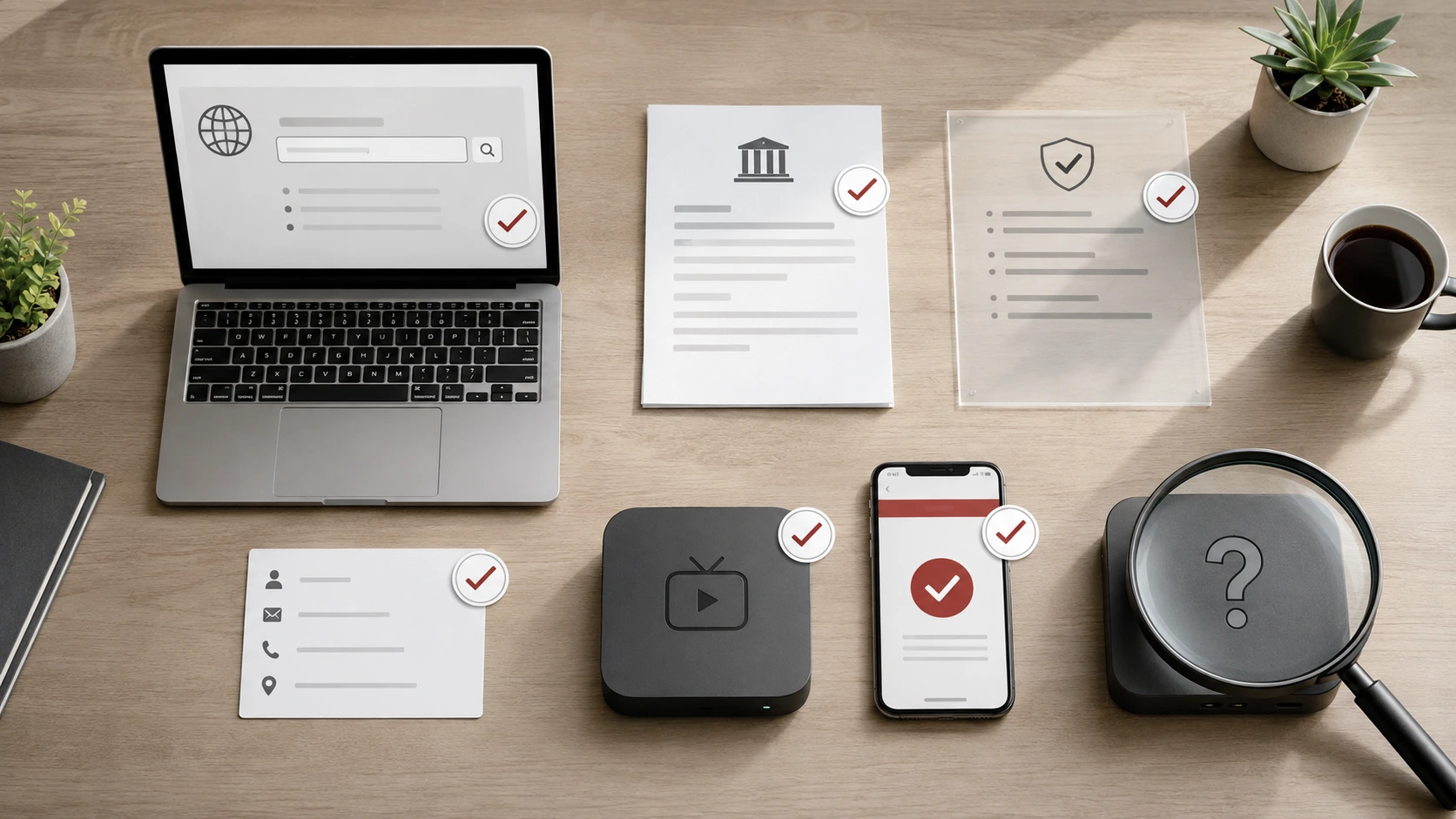
1. Look up who owns the domain. Domain holder records became broadly available again during 2025–2026, so this check works once more. For .fi names, Traficom's whois service does it. An empty result is no longer a neutral finding.
2. Look for an identifiable operator. Is there a company name, a country of registration, contact details? Does anyone reply before you buy? Someone reachable before payment is more likely to be reachable after it.
3. Count how many domains carry the same brand. The same name on ten extensions with different contact details indicates a reseller chain, not one company. That is not automatically evidence of anything unlawful, but it means you do not know who you are dealing with.
4. Read the terms and the price list. Are the price, the period and the renewal conditions stated clearly? Are there written terms at all?
5. Check the payment method. This proved central in the Nordicplay case. How is payment requested, and who receives it? Unusual payment arrangements are a telling sign.
6. Test before you pay. The simplest filter of all.
What domain records actually show
The first item deserves expanding, because many people give up at it unnecessarily.
Holder records typically show the registering party, the registration date and the registrar. Three observations are informative. A very recent registration for a service presenting itself as years established is a contradiction. A holder hidden behind a privacy service is now a choice rather than a default, since availability was improved by regulation. And a different holder on every domain carrying the same brand indicates a reselling chain rather than one company.
None of these proves anything unlawful on its own. Together they tell you how much you can actually establish before paying — which is the whole question. A service you can learn nothing about is not automatically bad. It is a service you have no tools to evaluate.
For comparison: with licensed operators and identifiable companies these details take a few minutes to find, along with a business ID and trade register entries. The difference is not subtle.
Promises that cannot be true
Some marketing claims are impossible regardless of who makes them. These are worth recognising because they need no background research — they collapse under their own logic.
| Claim | Why it cannot be true |
|---|---|
| Lifetime subscription for one payment | Broadcasting rights are time-limited and repurchased annually. Permanent access cannot be funded by a single fee. |
| Every channel in the world | Rights are national and exclusive. Nobody controls them all at once. |
| 100% uptime, never buffers | No streaming service is uninterrupted. The claim describes marketing, not engineering. |
| Named premium channels at a fraction of the price | Rights to individual competitions cost tens of millions. A price cannot be a fraction of the cost of the rights. |
| No identifying details needed | Every payment leaves a trace somewhere. The claim says more about the seller than the service. |
The fourth row is the most revealing and the easiest to check yourself. If a service advertises by name content whose Finnish rights went through a public tender, look up which party won them. That information is public and the comparison takes two minutes.
Why channel counts tell you nothing
One number appears in every marketing text and deserves its own note, because it carries the most weight and the least information.
A channel count is self-reported and verified by nobody. The counting method is not standardised: the same channel in different quality versions can be counted repeatedly, regional variants are counted separately, and the total typically includes a large number of channels nobody in Finland watches. The figure grows without the offering improving.
The comparison misleads in a direction few consider, too. Households demonstrably watch a handful of channels regularly. Whether a line-up holds 18,000 or 46,000 changes nothing about daily life if the five to ten you actually watch are missing or unreliable.
The useful question is different: do the channels I watch work, on my device, on my connection. No number in a brochure answers that — only a trial does. That applies to us as well: our own figure is as unverified as anyone's, which is exactly why we ask people to test before paying. Why line-ups move between countries and seasons is covered in the Nordic rights reshuffle.
Three models side by side
Strip away the brand names and there are essentially three ways to buy television in this region. Seen side by side, the difference is not price but how much you can verify in advance.
| Operator TV package | Credential-based subscription | Anonymous brand IPTV | |
|---|---|---|---|
| Operator identifiable | Yes, a listed company | Varies — and checkable | No, often deliberately hidden |
| Number of domains | One official site | Usually one | Often dozens across extensions |
| Terms of service | Public and binding | Public | Missing or vague |
| Pricing | Public, regulated | Public, per period | Unrealistically cheap, sometimes one-off |
| Trial before paying | Rarely | Usually yes | Varies, often not |
| If the service stops | Consumer protection applies | Period ends, refund negotiable | Nobody to claim from |
| Who receives payment | An identified company | An identified company | Often unclear |
The middle column is where you have to form your own judgement, and where the checklist above earns its keep. We are not claiming every credential-based service is alike. We are claiming the difference between the third column and the first two is verifiable in minutes if you know what to look at.
Note also what the table does not contain. Channel count is absent, because it separates nothing: it is a self-declared figure nobody audits. The same goes for picture quality and server promises. Every distinguishing factor is administrative — who, where, on what terms, and where the money goes.
What Nordic IPTV is — and what we do not claim
Since this is an IPTV service's own site, the obvious thing should be said out loud: we are not a neutral party here. So apply the checklist above to us as well.
Nordic IPTV is a credential-based subscription. What the service includes is on its own page: more than 18,000 live channels plus over 40,000 films and 12,000 series, in 4K and FHD where the source provides it, with an EPG and catch-up. Supported devices cover smart TVs, Android TV, the Fire TV Stick, Apple devices, computers and phones.
Pricing is public: €15 for one month, €35 for three, €45 for six and €65 for twelve — about €5.40 a month annually. Streams run from two to five depending on the plan, every plan is billed once with no automatic renewal, there is no fixed term, and each carries a 7-day money-back guarantee.
We do not claim to be the official rights holder for any channel or competition in Finland, and we do not promise our line-up will never change. We also make no assertions about any named competing brand, because we cannot verify their contracts any more than you can.
Who we are is stated openly, the FAQ covers the usual uncertainties, and if something is unclear, ask before you pay. The wider picture of Finnish television is in our guide to IPTV in Finland, and how to read what other customers say is covered in our article on reviews.
Summary
A brand name tells you very little in this market. The same service is sold under many names across many domains, and the name can change faster than the system behind it. Direct your assessment at what is checkable: who owns the domain, whether an identifiable company exists, whether terms are published, and whether you can test before paying.
Something new happened in the Nordics in 2026. Swedish authorities shut down Nordicplay and identified 4,886 subscribers — not from network traffic but from payments, because they had been made through a system tied to a personal identity number. At the same time Sweden is preparing a law that would make viewing finable from 1 July 2026. The proposal concerns Sweden rather than Finland, and it remains a proposal — but it is the first time in the Nordics that the viewer has been put forward as a target for penalties.
The practical conclusion is short. Do not judge a service by its name or its reviews. Judge it by who stands behind it and whether you can establish that yourself in a few minutes. That question costs less than the wrong answer.
To compare options with the numbers in front of you, see the plans and monthly prices. To test the quality on your own device first, start a free trial.